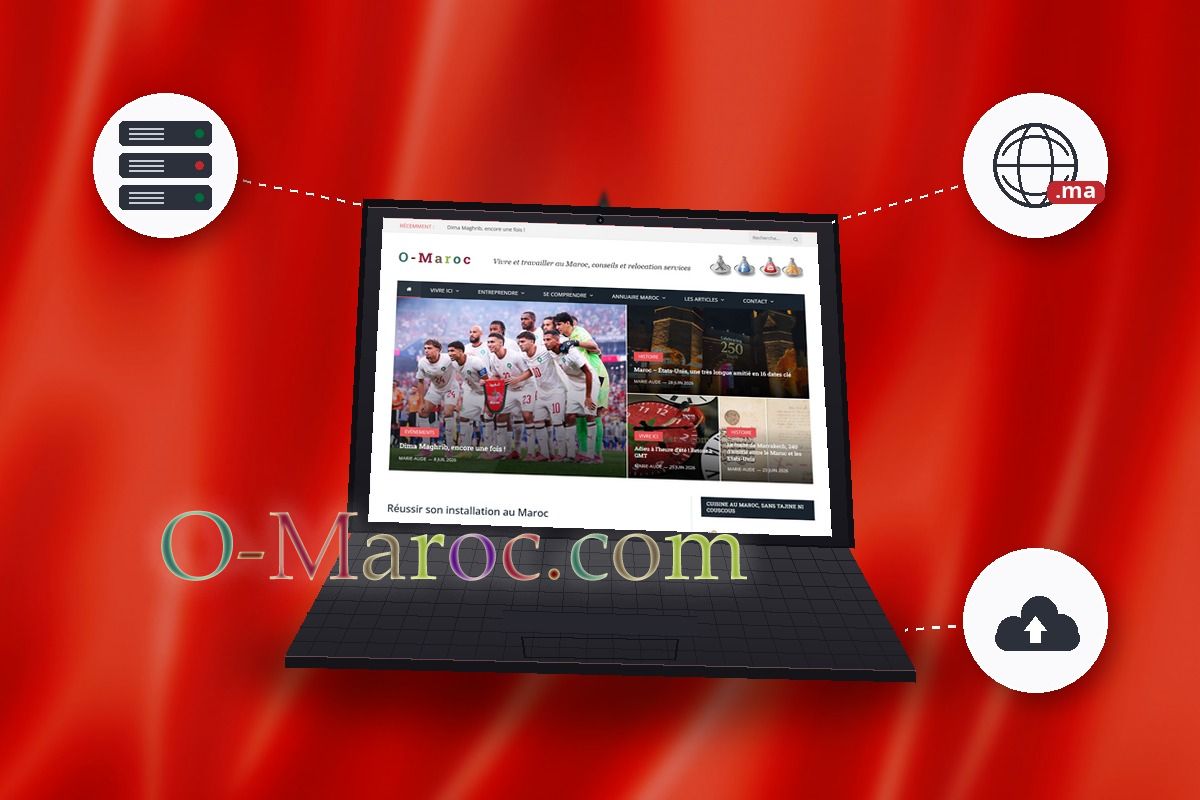
When Mezgarne (the travel agency’s website where it all began, and which is now part of O-Maroc) was launched in 2004, there were virtually no online travel services in Morocco, and those that did exist were expensive.
So we did “what everyone else does” – we bought the domain name and hosting from abroad. It was all the easier as we weren’t yet living in Morocco full-time, so we didn’t have any currency issues. At the time, I was living in Germany part-time, so we were hosted by 1&1 (Ein-und-ein in the original version), and when I say “we”, I mean Mezgarne, O-Maroc and about fifteen websites belonging to clients of my web agency.
When OVH launched in Morocco, we were really pleased, and we moved all our websites over to them. Unfortunately, our joy was short-lived; the quality of the local service wasn’t up to scratch, and we often had to get in touch with OVH France’s customer service team via Twitter – now X – (they were brilliant, mind you… but we weren’t actually their customers).
Moving around fifteen websites – with all the changes to DNS settings, email accounts, file transfers and databases – takes time. So I didn’t fancy trying out local hosting providers again, and I opted for a managed dedicated server, together with my partner.
However, as some of our clients were already using hosting services from Moroccan providers, we were able to try out other service providers, and some of them are very good.
Server location: Morocco or abroad?
The geographical location of a server – and therefore of a website – is important for search engine optimisation. This is because if you’re targeting a French audience (rather than a French-speaking one), a server in France – and therefore with a French IP address – will give you a slight advantage.
What’s more, your French visitors are likely to access your content more quickly (by a few thousandths of a second). For us, as we were targeting a French-speaking audience based in France, Morocco, Belgium, Switzerland, Canada, etc., this was a question worth considering.
At the time, there were virtually no data centres in Morocco. There was just one hosting provider – MTDS, I believe – which seems to have since stopped offering hosting services.
The impact of Law 09-08 on the protection of personal data
Enacted in 2009, this law prohibits, unless a derogation has been granted, the transfer of personal data abroad and, in particular, to countries not included on a list issued by the CNDP (National Commission for the Supervision of Personal Data Protection), which comprises countries offering a level of protection equivalent to that provided by Moroccan law.
These are:
- the countries of the European Union: Germany, Austria, Belgium, Bulgaria, Cyprus, Denmark, Spain, Estonia, Finland, France, Greece, Hungary, Ireland, Italy, Latvia, Lithuania, Luxembourg, Malta, the Netherlands, Poland, Portugal, the Czech Republic, Romania, Slovakia, Slovenia, Sweden,
- Canada,
- the United Kingdom,
- Switzerland,
- Norway,
- Iceland,
- Liechtenstein.
But not the United States.
However, in most cases, a web hosting provider based in Morocco does not have its own servers. And many of them offer hosting through Amazon Web Services or similar providers based in the United States
A luxurious option for hosting in Morocco.
All the major Moroccan hosting providers now offer a ‘server in Morocco’ option, but it is two to eight times more expensive than the hosting they continue to offer on servers abroad. If we were to set up an e-commerce project, we’d have to think twice. But not for a blog that doesn’t sell anything and whose only personal data consists of the names, email addresses and IP addresses from comments and contact forms, as well as subscriptions to comment threads and the newsletter.
Domain name registration
Registrar or reseller?
A registrar is a company accredited by ICANN (the global domain name administrator) or the ANRT (the administrator of .ma domain names) that sells domain names directly. A reseller buys domain names in bulk from a registrar to sell them to its own customers.
The advantages of registering directly through a registrar are:
- the price, which is generally lower
- direct technical support in the event of a problem.
Our domain names
Here too, our domain names have a ‘history’, having moved from 1&1 to Gandi, then to Bookmyname (Scaleways). But for the most recent one, we’ve once again opted for a local provider, Nindohost. All these companies are registrars.
A Moroccan service provider or a foreign service provider?
Whilst foreign providers are usually cheaper, it may nevertheless be worth using a Moroccan provider if you want a .ma domain name or, of course, a server with a Moroccan IP address.
Tax implications: VAT and withholding tax on the purchase of services from abroad.
However, the savings to be made by buying from abroad are offset by administrative burdens, at least for businesses. This is because services do not go through customs in the same way as goods. Yet it is during this customs clearance process that the importer pays VAT.
In this context, the importer is the company that pays for the service. It must therefore:
- Self-assess the VAT in your monthly return; this is a cash-neutral transaction, as the VAT ‘payable on importation’ is offset by the deductible VAT. However, if you fail to do so, in the event of an audit, you will have to pay this import VAT, plus late payment penalties, and will not be able to deduct it!
- pay the corporation tax at source, which is equal to 10 per cent of the invoice amount. And this 10 per cent can make purchasing abroad less profitable…
 A typo or syntax error? You can select the text and hit Ctrl+Enter to send us a message. Thank you! If this post interested you, maybe you can also leave a comment. We'd love to exchange with you !