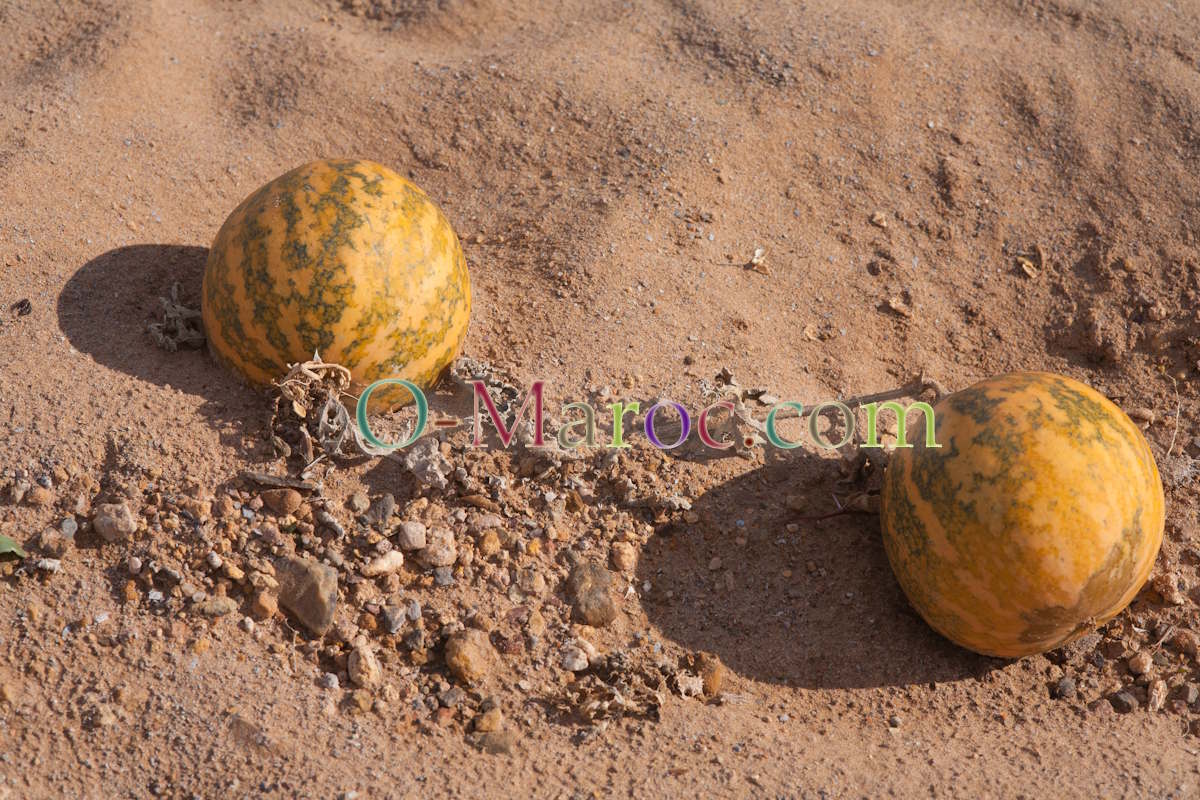
It’s called the desert melon because of its round shape and yellow colour, but in reality it has absolutely nothing to do with a melon.
Citrullus colocynthis, known in English as colocynth or bitter cucumber, is a member of the Cucurbitaceae family; in other words, it is a squash. Like the melon and the cucumber, although these belong to the Cucumis genus rather than the Citrillus genus.
Finally, its arabic name is حنظل .
Now that we’ve covered these essential botanical details, let me introduce you to what the locals call the desert melon.
The desert melon grows in the sand
It grows in the sand, where its few fruits can be seen scattered in a hollow – no doubt the bed of a wadi (now dry, though there may be water there underground) or a floodplain, which fills with water during the rare rainfall. Thanks to its very long roots, it is able to reach water deep underground.
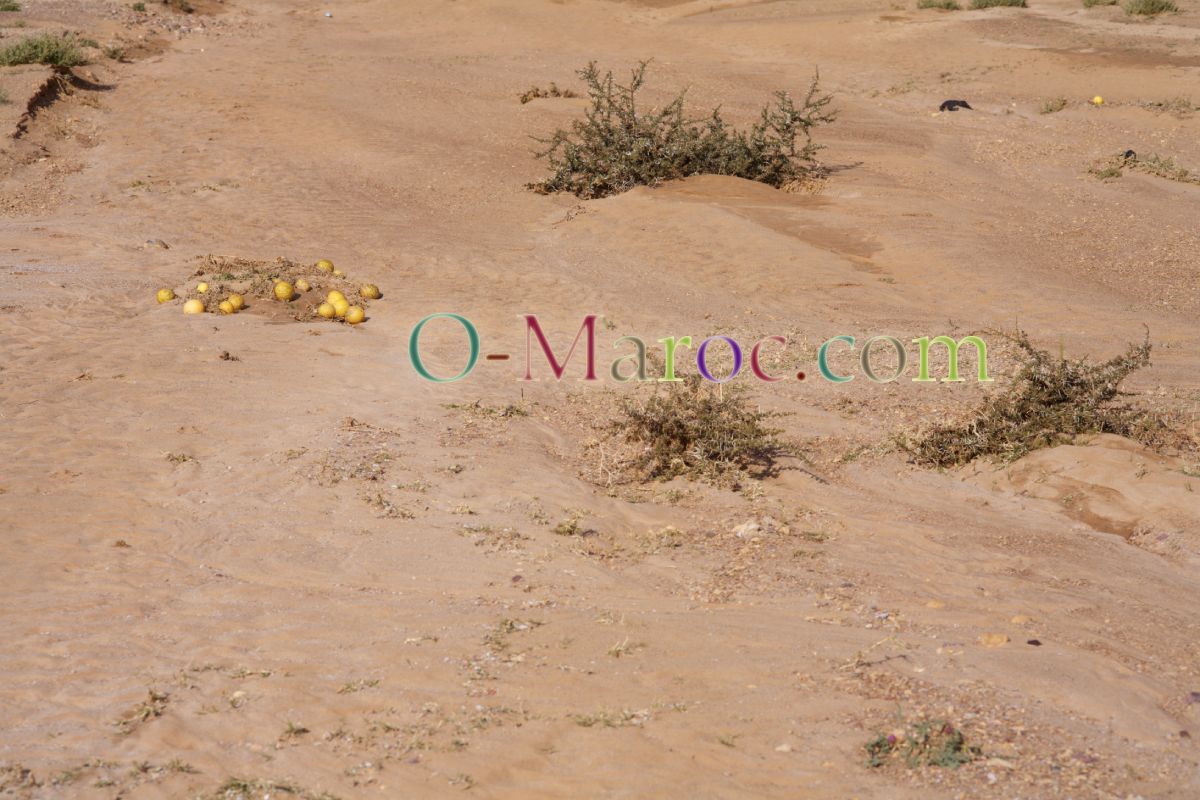
You really need a keen eye to spot them!
It has long, creeping stems bearing alternate, serrated leaves, which are very often dried out and barely visible. The stems are covered in short, stiff hairs that do not cause stinging. The flowers, consisting of five more or less fused pale yellow petals, are often hidden by the foliage.
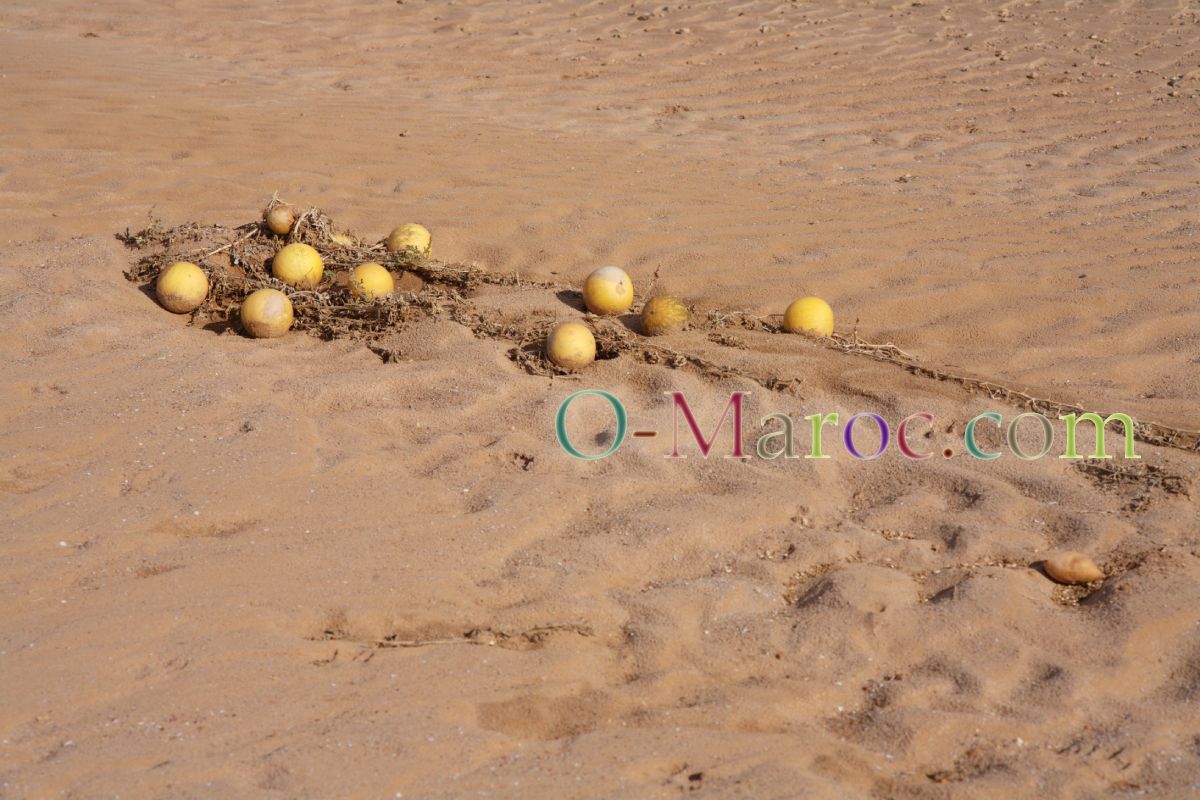
The smooth, spherical fruits, with their fleshy pulp, are the most visible part of the plant. Initially green with creamy-white marbling, they turn straw-coloured as they dry and remain on the plant in their dried state for a long time.
A highly poisonous fruit
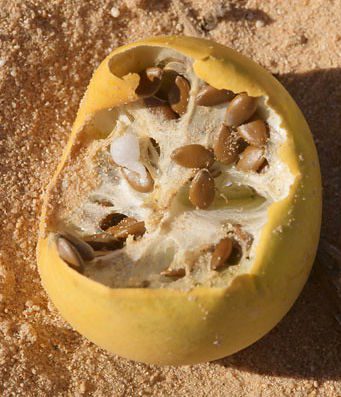
Its flesh is light and spongy, and orange-yellow in colour. It is very bitter and poisonous. However, its seeds are edible.
To make it somewhat edible, the Arabs used to eat its flesh after soaking it in water and salt and leaving it in the sun until its bitterness had gone; they would then press it to extract an oil, which they added to flour to make porridge. But it remained a food of last resort, to be eaten when there was nothing else available.
Medical uses
When harvested before ripening and dried, the flesh is used as a very potent laxative. It is also used as an anti-rheumatic and as a remedy for skin infections. It is also an effective anthelmintic against nematodes (roundworms, pinworms) and cestodes such as tapeworms.
The seeds, which are edible, have an insulin-stimulating effect. When roasted, they have a nutty flavour and are eaten whole in some African countries. (But not in Morocco).
The roots have purgative properties and are used to treat jaundice, rheumatism and urinary disorders.
Consumption by animals
Goats graze on its flowers, and donkeys enjoy its leaves, but other animals avoid it because of its strong bitterness. Camels, in particular, show no interest in it.
 A typo or syntax error? You can select the text and hit Ctrl+Enter to send us a message. Thank you! If this post interested you, maybe you can also leave a comment. We'd love to exchange with you !