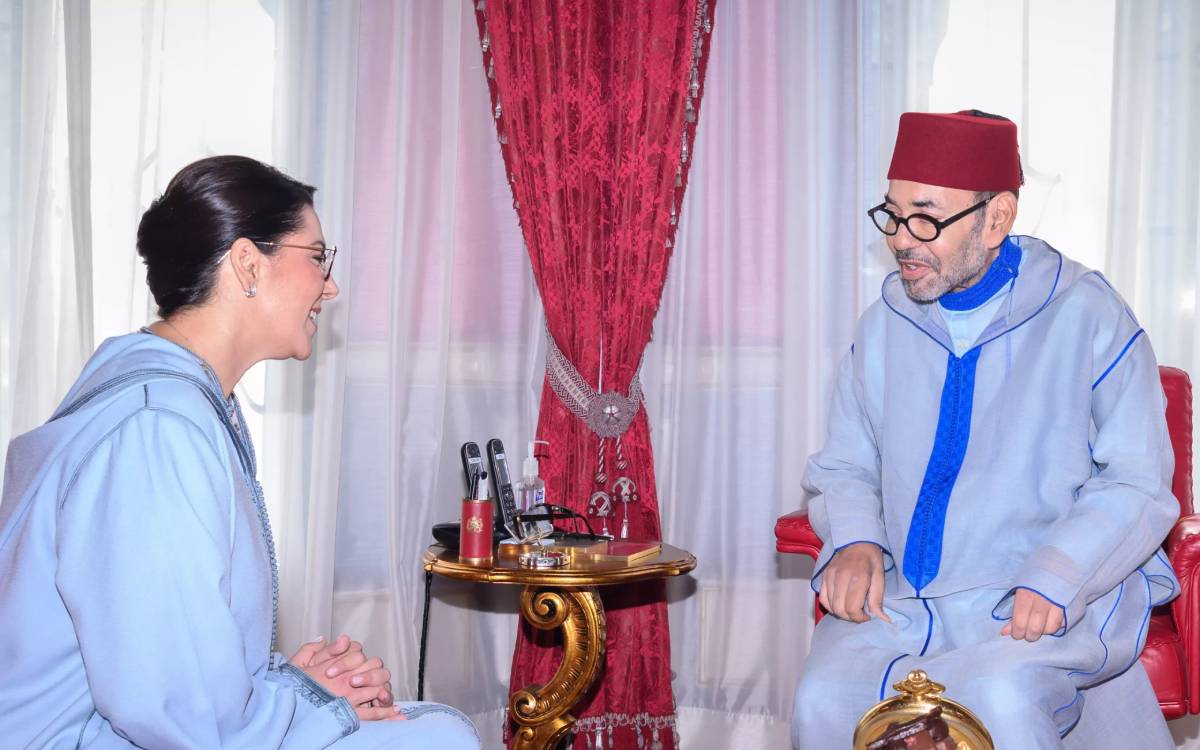
Fatima Ezzahra El Mansouri has joined the very exclusive club of female heads of government, which currently has only ten other members.
Whilst this is a first for Morocco, it was preceded in the Muslim world by Benazir Bhutto, who came to power in Pakistan in 1988, and, in the Maghreb, by Najla Bouden, who led the Tunisian government between 2021 and 2023.
A friend on Facebook asked me
So, are you happy? A female Prime Minister🙂?
My first reaction was, “I couldn’t care less; what matters are his skills and his programme.”
And then I saw the reactions online. A barrage of sexist and utterly inappropriate comments. Whilst the vast majority of them come from Moroccans living abroad, they can also be found in Morocco.
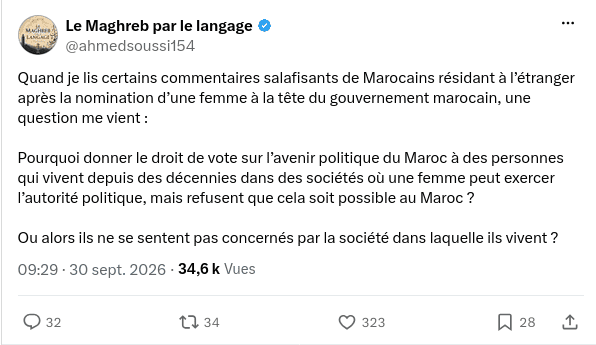
When I read certain Salafist-leaning comments from Moroccans living abroad following the appointment of a woman as head of the Moroccan government, a question springs to mind: Why grant the right to vote on Morocco’s political future to people who have lived for decades in societies where a woman can exercise political authority, yet refuse to accept that this should be possible in Morocco?
Three areas of sexist criticism
The hadith: “A people who entrust their affairs to a woman will not prosper”
An authentic hadith, reported by Al-Bukhari, which is used by religious leaders to oppose the appointment of the Prime Minister.
Except that…
- they forget that Morocco is still ruled by the king;
- for some, such as Mustapha Ramid, a former PJD Minister of Justice, it is a contextual hadith, relating to the situation of the Persian people;
- and he points out that the Queen of Sheba, by contrast, was praised in the Qur’an;
- finally, Morocco has already been ruled by women, such as Sayyida Al Hurra
Prayer with the King
The second question – which was actually asked in over three minutes by a journalist – was: “But how are you going to pray with the King?”
Indeed, the King, as Commander of the Faithful, Amir al-Mu’minin, leads a prayer with his government on four occasions:
- for Eid al-Fitr
- for Eid al-Adha
- for Laylat al-Qadr
- and to mark the Mouloud
and in Islam, women do not pray alongside men, but behind them.
Except that…
- Although these moments are significant from a religious perspective, they have nothing to do with her ability to govern•
- The matter has already been settled in accordance with protocol, as the previous government included seven women (including the new Prime Minister) and, until now, this had not posed a problem for anyone!
Her divorce
Finally, these critics asked how she could run a country when she had not “managed to make her marriage work”. The implication, of course, was that the divorce was entirely her fault.
Except that…
The king is divorced too.
And French machismo: the veil, the veil again
Finally, let us not applaud the reaction of the Socialist Julien Dray, who is still harping on about the same old issue, by welcoming the fact that a woman has been appointed – and that she is not veiled
For him, it’s an ‘extra quality’… how can I put it?
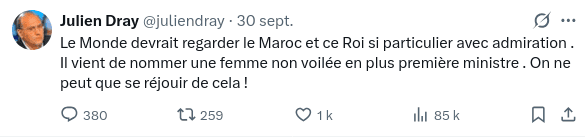
The world should look to Morocco and this rather unusual King with admiration. He has just appointed a woman – who does not wear a headscarf – as Prime Minister. One can only welcome this!
So yes, seeing these reactions, I’m pleased that a woman has been appointed Prime Minister.
A job full of pitfalls
One might nevertheless wonder whether Fatima Ezzahra El Mansouri was appointed because of her – genuine – qualities, or because no one else was available to take the post.
The other two potential prime ministers mentioned did indeed have some ‘skeletons in the cupboard’: Abdellatif Ouahbi, the former Minister of Justice, failed to push through the reforms and had to deal with a revolt by the lawyers.
As for Fouzi Lekja, who has recently entered politics, he has decided not to stand as a candidate in Berkane and, more importantly, he strongly criticised the RNI on 12 September, describing its track record as “catastrophic”. On 8 September 2026, Lekjaa also dismissed the RNI’s criticisms of his new party’s election manifesto as “ignorance”. It will be difficult to build a governing majority after that! He will therefore devote himself to the 2030 World Cup.
Morocco is not in a particularly rosy economic situation: there is a threat of disinflation, the number of unemployed young people remains as high as ever, and the incidents in Ceuta have highlighted the desperation of these young Moroccans, who are prepared to do anything to try their luck elsewhere.
In these circumstances, the challenges facing Fatima Ezzahra El Mansouri – starting with forming a government – are considerable!
Did you know?
The first female prime minister was Sirimavo Bandaranaike of Sri Lanka in 1960.
The first female Muslim head of government was Benazir Bhutto of Pakistan in 1988.
The first female head of government in the Arab world was Najla Bouden of Tunisia in 2021.
 A typo or syntax error? You can select the text and hit Ctrl+Enter to send us a message. Thank you! If this post interested you, maybe you can also leave a comment. We'd love to exchange with you !