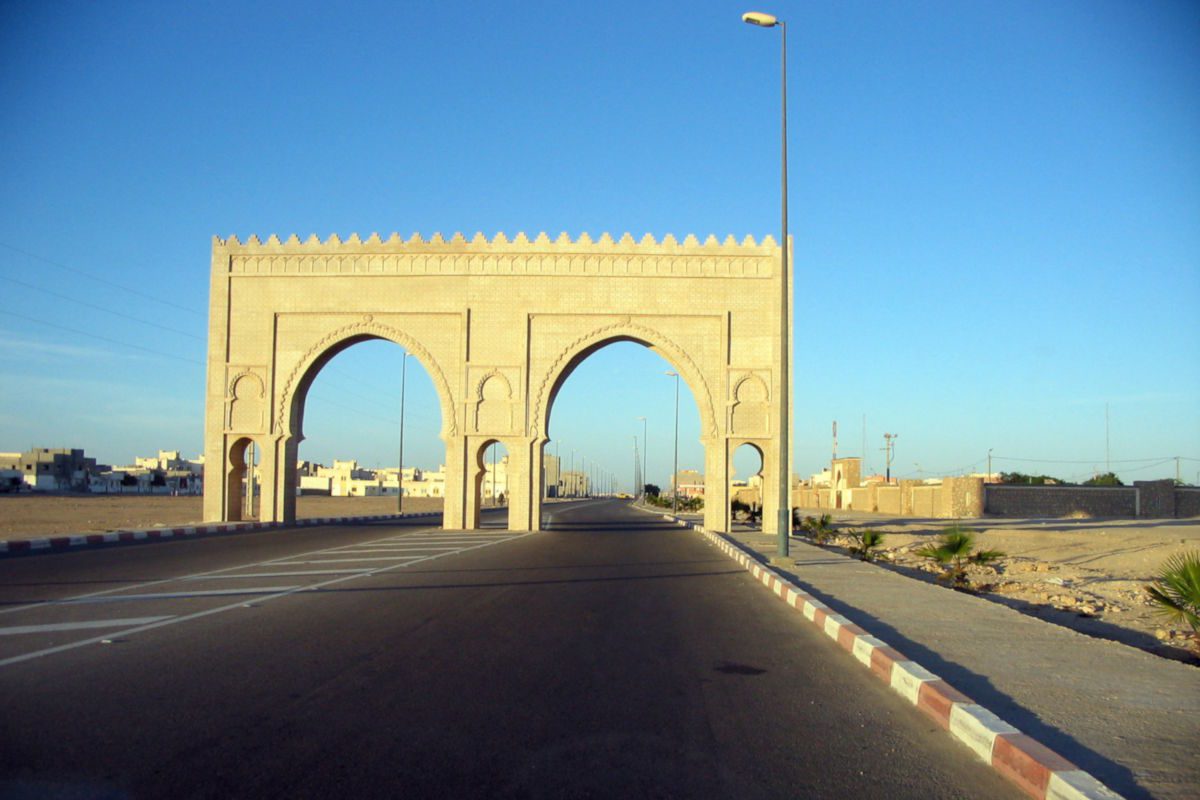
14 August is a public holiday in Morocco, marking the anniversary of the recovery of the province of Oued Eddahab.
It commemorates an event that took place in 1979, four years after the Green March.
But hang on, I thought it was the Green March that had restored the southern provinces – the former Spanish Sahara – to Morocco?
Not exactly.
The Madrid Agreements of 1975: a provisional tripartite administration
Signed in Madrid on 14 November 1975, eight days after the Green March and six days before Franco’s death, the Madrid Agreements set out the partition of Spanish Sahara, dividing it into two parts:
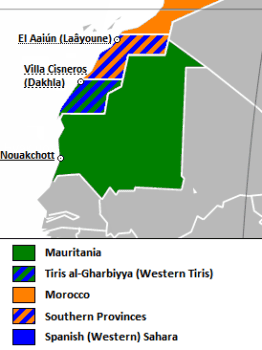
- to the north, the ‘Southern Provinces’ – that is, the Laâyoune-Sakia El Hamra region – are entrusted to Morocco;
- To the south, the province of Tiris al-Gharbiyya (or Western Tiris) – that is, the present-day Dakhla-Oued Eddahab region – was ceded to Mauritania.
The Madrid Accords did not assign any role to the Polisario Front, which went into exile in Algeria.
Spain undertook to withdraw from the territory on 28 February 1976, and in the meantime, the territory would be administered by the Spanish Governor-General, assisted by two Deputy Governors – one Moroccan and the other Mauritanian – who would respect Sahrawi public opinion. Mauritania, which had claimed these territories as part of ‘Greater Mauritania’, accepted these agreements, believing – no doubt rightly – that Morocco, bolstered by its military superiority, would otherwise have annexed the entire territory.
That is why the United Nations Under-Secretary-General for Legal Affairs, Hans Corell, stated in 2002 that
The war between Mauritania and the Polisario Front
Clashes regularly took place with the Polisario Front. This marked the start of the Western Sahara War. The Polisario Front and Algeria both regarded the advance by Morocco and Mauritania as a foreign invasion, whilst Morocco and Mauritania saw the fight against the Polisario Front as a battle against a separatist group.
By 1977, Mauritania, facing severe economic difficulties, was keen to bring an end to this costly war, which was causing discontent within the armed forces. Following a coup d’état, the new president, Colonel Mustapha Ould Saleck, led a military junta that advocated a moderate, pro-French and pro-Moroccan approach. Following lengthy negotiations with the Polisario Front, a new military junta renounced its claims to Western Sahara by treaty on 5 August, recognising the Polisario Front as the sole legitimate representative of the people of Western Sahara. These were the Algiers Agreements.
Morocco has effectively regained the province of Oued Eddahab
Morocco immediately occupied the territory, taking the Polisario Front and Mauritania by surprise.
Morocco deployed its army. And on 11 August 1979, the Moroccan flag was flying in Dakhla.
And on 14 August, a delegation comprising representatives of all the tribes, local dignitaries and religious scholars from that province travelled to Rabat to pledge allegiance to the King of Morocco, Hassan II, who was accompanied by his sons, the future Mohammed VI and Moulay Rachid. Dressed in white, alongside the Sahrawis in blue and white, under the leadership of Sheikh Ahmed Habib Allah Ould Bouh, the elder and caid of Dakhla, they presented a scene designed to leave a lasting impression.
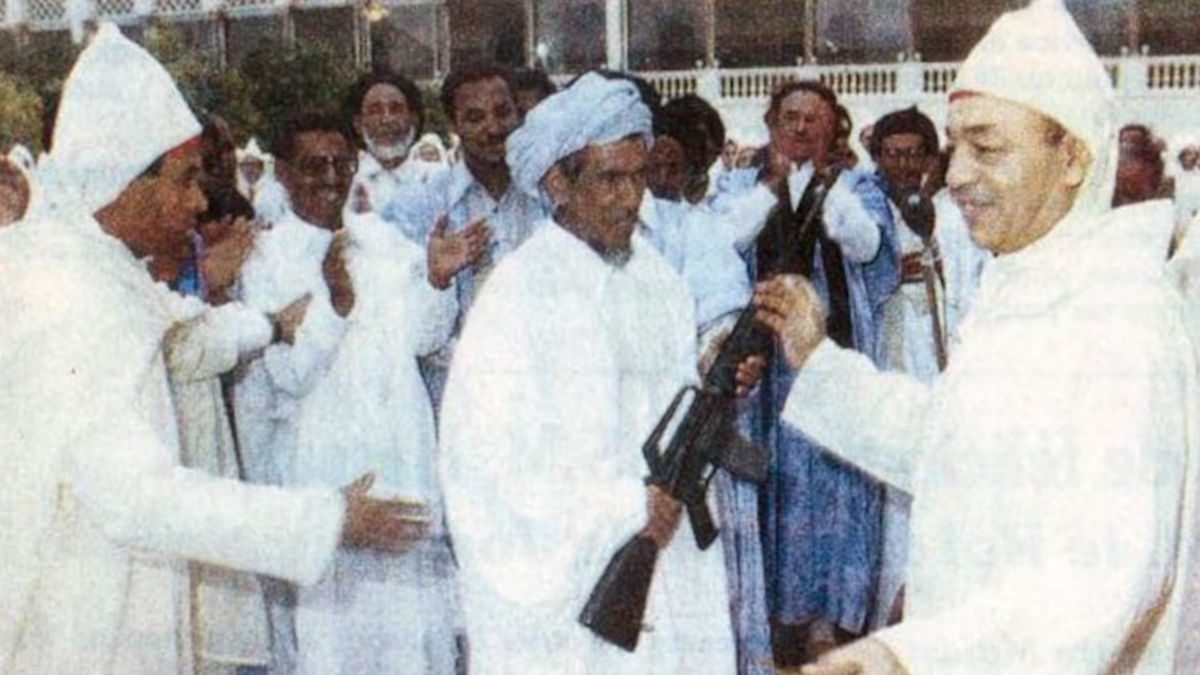
As a symbolic gesture, Hassan II presented them with weapons. He then responded to their pledge of allegiance with a speech in which he undertook to
The Polisario’s counter-attack: the Battle of Lebouirate
Ten days later, on the night of 24 August 1979, the Polisario brought the war onto Moroccan territory by attacking a Moroccan garrison at Lebouirate, in an area not claimed by the Polisario.
Between 150 and 5,000 men inflicted heavy losses on the Moroccan army – between 50 and 800 dead, depending on the source – and a great deal of military equipment was destroyed or seized. Lebouirate remained in Polisario hands for nearly a year. The nearby village of Zag was besieged by the Polisario from December 1979 to May 1980.
In 1980, Morocco began construction of the ‘Wall of Sand’, stretching over 2,720 km. The conflict became deadlocked for decades.
Morocco is working to ensure the well-being of the Sahrawi people
In keeping with Hassan II’s promise, and also out of a well-understood interest in winning over the local population, Morocco supports the economic development of these provinces. Tax exemptions, investment incentives and development programmes – every effort is being made to ensure the region’s development.
It welcomes tourists who come to enjoy the surfing spot at Dakhla, but above all it is a fishing hub, where aquaculture and renewable energy projects are being developed.
 A typo or syntax error? You can select the text and hit Ctrl+Enter to send us a message. Thank you! If this post interested you, maybe you can also leave a comment. We'd love to exchange with you !