The two latest dahirs published in Arabic in the Official Gazette to include Yennayer among Moroccan public holidays provide an opportunity to take stock of public holidays in employment law: are they compulsory, and how are they paid when worked?
Public and private holidays are different
Moroccan civil servants enjoy a few days more holiday than private sector employees. Some collective labour agreements, such as the banking sector, have been brought into line with the civil servants’ scheme.
A number of religious and other celebrations are not public holidays.
But practice also differs from the law: in general, people take three days or more for Eid El Kebir, either donated by the company or as paid leave.
Legal public holidays in Morocco
| Name | Date | Private sector | Administrations |
| New Year | 1st January | 1 | 1 |
| Independance Manifesto | 11 January | 1 | 1 |
| Amazigh New Year | 14 January | 1 | 1 |
| Eid el Fitr | Wednesday 10 March 2027 | 1 | 2 |
| Labour Day | 1st May | 1 | 1 |
| Eid El Kebir | Monday 17 May 2027 | 1 | 2 |
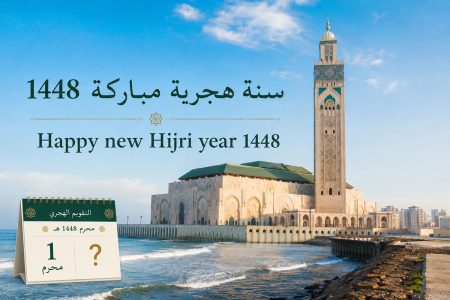
| Islamic New Year, Ras El Am | Sunday 6 June 2027 | 1 | 1 |
| Throne Day | 30 July | 1 | 1 |
| Wadi Eddahab allegiance festival | 14 August | 1 | 1 |
| Anniversary of the Revolution of the King and the People | 20 August | 1 | 1 |
| Youth Festival | 21 August | 1 | 1 |
| Mawlid | Sunday 15 August 2027 | 1 | 2 |
| Unity Day | 31 October | | |
| Green March | 6 November | 1 | 1 |
| Independance Day | 18 November | 1 | 1 |
Public holidays corresponding to dates in the Muslim calendar are determined by the appearance of the crescent moon. They are therefore given to the nearest day.
“Local” public holidays
These are not, of course, listed in the law, but correspond to moussems and other special celebrations. For example, the Boujloud in Agadir may well be a “local public holiday”, but as it falls on the day after Eid, it is paid anyway for civil servants and bankers!
Articles 217 to 230 of the Moroccan Labour Code deal with public holidays.
You will find below the exact text of the Moroccan Labour Law for your reference.
Labour code articles - Click on the cross or the light bulb to unfold
Article 217 : public holidays must not be worked
Employers are prohibited from employing employees on paid public holidays, the list of which is determined by regulation.
Article 218 : payment for public holidays
It may be decided that the public holiday will be paid as actual working time.
Article 219 : compensation for employees paid by the hour or by the day
An employee paid by the hour or by the day receives compensation for the paid holiday equal to the remuneration he would have received if he had remained at his workstation, with the exception of risk compensation or reimbursement of costs and expenses incurred by him in the course of his work.
The employee is entitled to paid holiday rest if he is employed immediately before the holiday or during the thirteen days of the month preceding the holiday.
Article 220 : compensation for employees paid by task
The holiday pay due to an employee whose salary is fixed by task, output or piecework is equal to one twenty-sixth of the remuneration received for the twenty-six days of actual work immediately preceding the paid holiday.
Article 221 : compensation for flat-rate employees
Where pay is fixed on a weekly, fortnightly or monthly basis, the corresponding remuneration may not be subject to any reduction as a result of unemployment on a paid holiday or public holiday, even where that day is not declared as paid.
Article 222 : coincidence of public holiday and weekly rest day
Where rest on a paid public holiday or a declared paid public holiday is given on the day on which the employee referred to in Articles 219 and 220 above benefits from his weekly rest by rotation, the employer must pay him compensation for this day under the conditions provided for in article 219 above.
Article 223 : opportunities to work on a public holiday
In establishments whose operation is necessarily continuous due to the nature of their activity or which have adopted the weekly rest period in rotation, work may not be interrupted on a paid holiday or public holiday.
The same provisions may be applied in food retail establishments or, where they have not adopted a weekly rest period in rotation, in cafés, restaurants, hotels, entertainment establishments or establishments where materials liable to deteriorate rapidly are used.
Article 224 : payment for public holiday worked
In the cases provided for in article 223 above, the employer must pay his employees who work on a paid public holiday or declared paid public holiday, with the exception of the employees referred to in the 2nd paragraph below, in addition to the salary corresponding to the work performed, an additional indemnity equal to the amount of this salary.
Employees paid in full or in part by tips are entitled to one day’s paid compensatory rest, even if they are guaranteed a minimum wage by the employer. This rest day is in addition to the paid annual leave.
Article 225 : compensatory rest for public holiday worked
By agreement between the employer and any employee referred to in the first paragraph of article 224 above who has been employed on a paid public holiday or public holiday, the additional indemnity provided for in the said article may be replaced by paid compensatory rest, granted to the employee under the conditions provided for in the second paragraph of the said article.
Article 226 : additional compensation
Where the employer has caused all or some of his employees to work in breach of the provisions of article 217, he must pay them, in addition to the pay for that day, compensation equal to 100% of the pay for that day.Compensation due in the event of breach of the provisions concerning work on a paid public holiday.
Article 227 : recovery of working hours lost as a result of the public holiday
Working hours lost due to a public holiday may, after consultation with the employees’ representatives and, where applicable, the trade union representatives in the company, be recovered during the thirty days following the said day, without the recovery being carried out on the day on which the employee must benefit from his weekly rest, and without it having the effect of increasing the working time beyond ten hours per day.
Recuperation may be carried out on the day of the weekly rest period in use at the establishment. However, recuperation may not be carried out when the weekly rest day coincides with a paid public holiday.
The employer must inform the Labour Inspectorate in writing of the dates on which the time off will be taken.
Article 228 : payment of recuperation time
Recuperated hours are paid under the same conditions as normal working hours.
Article 229 : recovery of hours for local public holidays
Where, by virtue of the collective labour agreement, the internal rules of an establishment or custom, employees are granted a rest period on public holidays other than those paid and fixed by article 217 or on public holidays, in particular on the occasion of local festivals or events, the hours lost must be recovered in accordance with the conditions laid down in article 227, whether or not the rest period is paid.
Article 230 : sanctions
The following are punishable by a fine of between 300 and 500 dirhams :
- the employment of employees on paid public holidays and bank holidays ;
- failure to pay for public holidays declared to be remunerated as actual working time under article 218 ;
- compensation not assessed in accordance with the provisions of post 219 ;
- failure to pay the indemnity provided for in article 224 to employees of the establishments referred to in Article 223 who have worked on a paid public holiday ;
- compensatory rest provided for in article 224 (2nd paragraph), and in article 225 not granted or granted in breach of the provisions of the said articles ;
- failure to pay the indemnity provided for in article 226 ;
- the recovery of working hours lost as a result of the public holiday under conditions that do not comply with the provisions of the 1st and 2nd paragraphs of article 227 ;
- failure to inform the Labour Inspectorate of the dates on which recovery will take place, or failure to do so in accordance with the provisions of the last paragraph of article 227 ;
- payment for hours recovered not in accordance with the provisions of article 228.
The fine is applied as many times as there are employees in respect of whom the provisions of this chapter have not been complied with, without however the total of the fines exceeding the amount of 20,000 dirhams.
Working on a public holiday
The public holidays listed above are compulsory days off, unless the company has organisational constraints.
These have to be actual constraints:
- a technical organisation that cannot be stopped, for example an industrial process (there are no blast furnaces in Morocco, but this is the example that immediately springs to mind)
- a public service that cannot be stopped (electricity, water, hospitals, etc.) or for which a minimum service must be provided (transport)
- a customer for whom we cannot stop providing a service (call-centres, for example)
- an activity geared towards the end consumer, in particular everything related to hospitality and tourism, which is specifically listed in the law.
Some public holidays are much more important than others for Moroccans. That’s why almost everything is closed on Eid, because there won’t be any customers anyway, except the rare tourists, or foreign customers for off-shore companies.
Payment of public holidays
Public holidays are paid as if they had been worked. The Labour Code sets out how this is to be done for employees paid by the day, by task or on a fixed-rate basis.
Payment of compensation or recovery of public holidays worked
In any event, the public holiday is paid. But the employee must also receive compensation equal to 100% of his or her salary.
If they agree, the employer and employee can agree to replace this compensation with an extra day’s rest, paid of course. Financially, this amounts to the same thing. On the other hand, the employee benefits from an additional ‘holiday’ day.
Public holidays falling on a Sunday, a weekly rest day or during an absence from work
Public holidays falling on a Sunday or a weekly rest day do not give rise to additional pay or recuperation if they are not worked. If the employee is paid by the day, the day is paid. If the employee is paid on a flat-rate basis, there is no additional remuneration.
Similarly, public holidays falling during sick leave are neither paid nor recovered, as the employment contract is suspended. (The same applies during a lay-off).
Public holidays falling during a period of leave do not give rise to the deduction of a day’s paid leave.
Finally, public holidays falling within the period of notice do not extend the period of notice.
Recovery by the company of hours not worked
With the agreement of the trade unions or staff representatives, the company can ask its employees to make up the hours that should have been worked on the public holiday.
This involves working overtime, which is:
- paid at the normal rate, with no extra pay
- limited to a maximum of 10 hours’ work per day
- performed within 30 days of the public holiday
- not be performed on the weekly rest day
- notified in advance to the Labour Inspectorate
Penalties for non-compliance
Various breaches of the law (days worked, incorrect compensation, etc) are punishable by a fine of between 300 and 500 dirhams per person, with a limit of 20,000 dirhams (i.e. 40 people).
Give more days for a public holiday?
Giving additional days
This is often the case for companies that align themselves with public sector conditions, either to please their employees or because their sector of activity involves working mainly with government departments or banks.
In this case, the company can simply decide to remain closed and pay the extra day as normal, without deducting it from its employees’ paid holidays.
Extending the closure of the company
If, for example, you wish to close your business for the week of Eid, that is your prerogative as manager.
In that case, you can force your employees who are entitled to it to take the necessary paid leave. For those who are not entitled, you will still have to pay them for these days, since it is you who is taking the decision to prevent them from working.
Finally, you must inform the Labour Inspectorate.
This procedure is normally reserved for annual closures. It will apply more in the case of a closure imposed for Ramadan. Your annual closure must be of a certain duration and be unique for it to apply.
 A typo or syntax error? You can select the text and hit Ctrl+Enter to send us a message. Thank you! If this post interested you, maybe you can also leave a comment. We'd love to exchange with you !