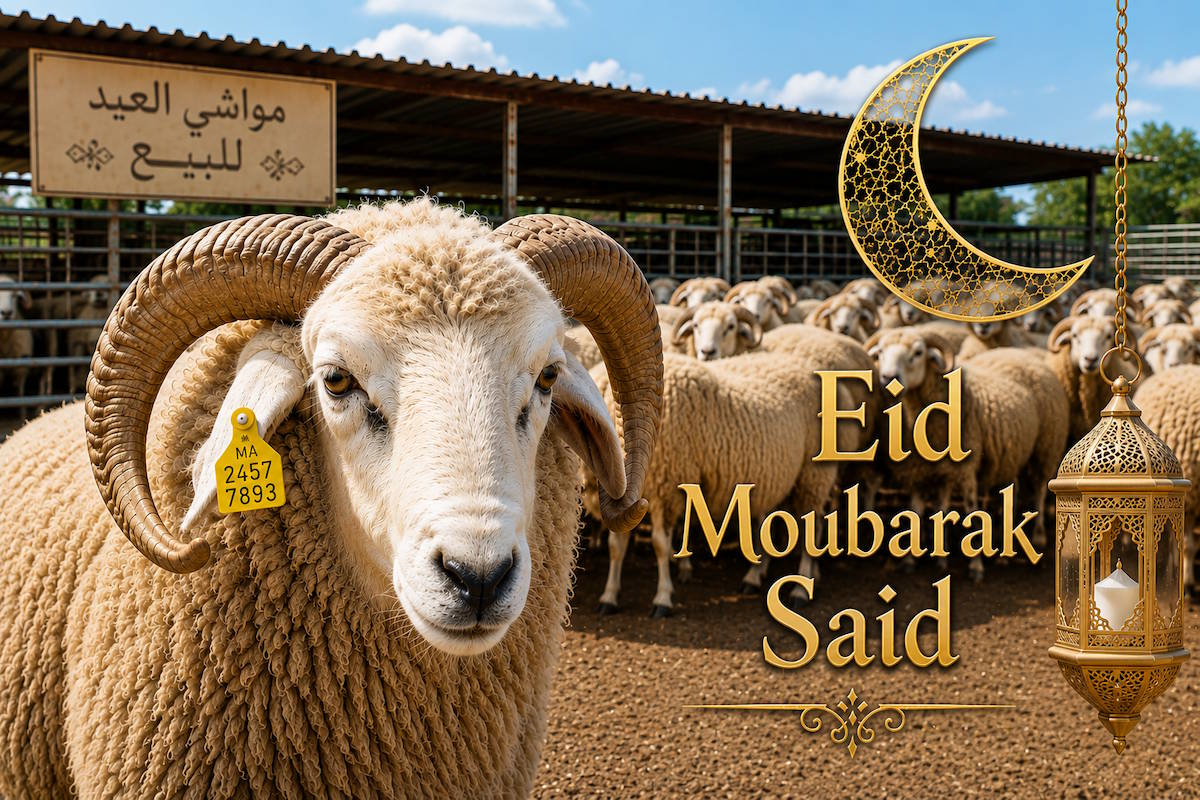
Following 2024, when the price of sheep for Eid rose to 6,000 dirhams, and 2025, when no sacrifices were made, 2026 looks set to be a better year for Moroccans, who will be able to find a sheep at a reasonable price.
A sheep costing between 2,500 and 3,500 dirhams
Although the Minister of Agriculture had initially announced prices of around 1,000–1,500 dirhams before backtracking, the market price seems to have stabilised at around 2,500–3,500 dirhams, which is 40% of the 2024 price and less than the minimum wage! However, the finest animals can fetch up to 9,000 dirhams; prices are also certain to rise in the final days leading up to the festival.
An (overly?) abundant supply
The rebuilding of livestock numbers and massive imports have led to an extremely abundant supply: 8 million head of cattle against an estimated demand of 5 million. This partly explains the fall in prices.
But importers have also been accused of making exorbitant profits.
Importers’ margins
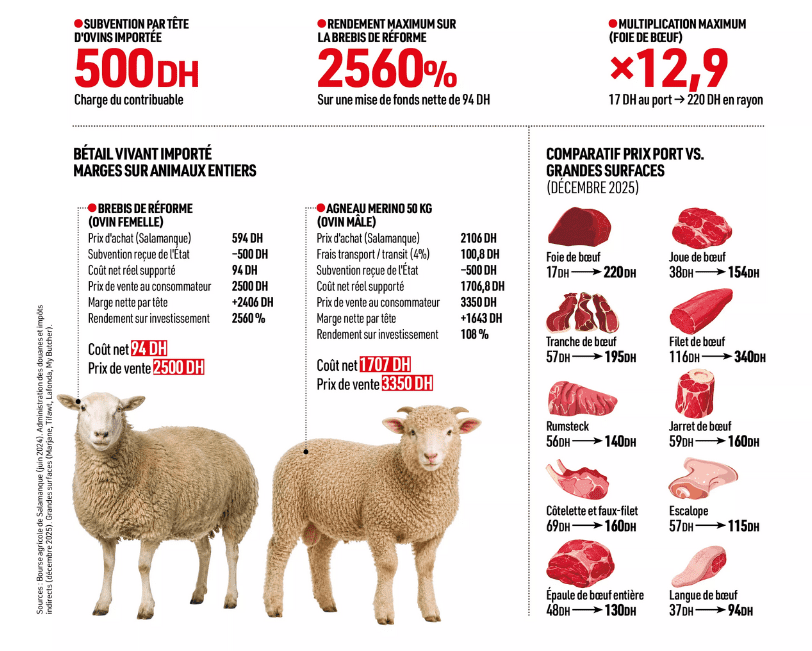
In fact, the Moroccan government subsidises sheep imports to the tune of 500 dirhams per animal.
According to this infographic produced by Tel Quel, the retail price of imported sheep in Spain is 2,106 dirhams (the left-hand column refers to females, which cannot be used for slaughter). With the state subsidy included, the sheep costs 1,700 dirhams… and is sold to the consumer for 3,350 dirhams, representing a profit of over 100%… paid for twice over by the consumer, as it is their taxes that fund the state subsidy.
What is known as the ‘Fraqchiyas scandal’ (involving middlemen and speculators) has dominated the headlines, yet the government appears unable to take action. During parliamentary debates, the Minister for Agriculture, Ahmed El Bouari (the man who had spoken of sheep costing 1,000 dirhams), claimed he did not know where to find them.
And to drive prices up even further, the Fraqchiyas enlisted influencers who made videos explaining that sheep prices were skyrocketing and that people needed to buy quickly – and at a high price – to be sure of getting their animal. Worse still, ‘actors’ posing in turn as farmers, customers or journalists were used to lend credibility to these so-called high prices.
Eid adverts
No advertising for sheep loans
For several years now, credit schemes for Eid sheep have disappeared from the market. This practice is entirely haram, for two reasons: firstly, because credit constitutes riba (usury), and secondly, because one should only pay for a sheep if one is able to do so.
Nevertheless, we have seen the emergence of adverts for consumer credit, which have no connection to Eid other than the timing. And the amounts involved are significantly higher, in the region of 30,000 dirhams: with these loans, people are financing Eid, their holidays and the start of the new school year!
Special offers on household appliances
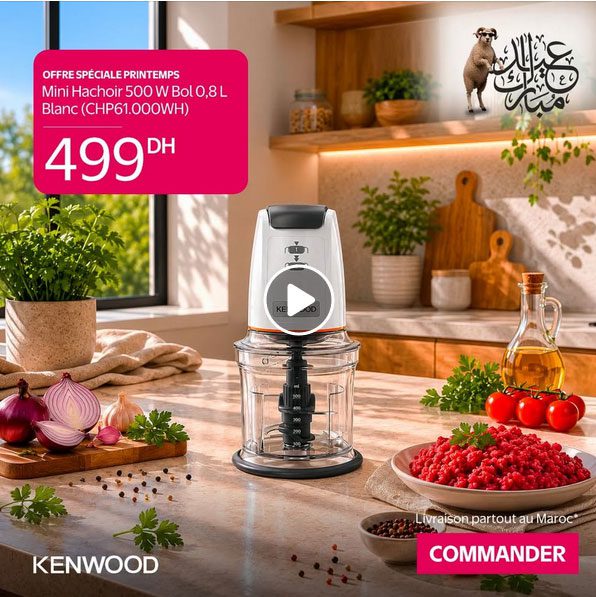
The three weeks leading up to Eid are the perfect time to stock up on household appliances. There are loads of special offers on freezers and fridges, small appliances, grills and skewers…

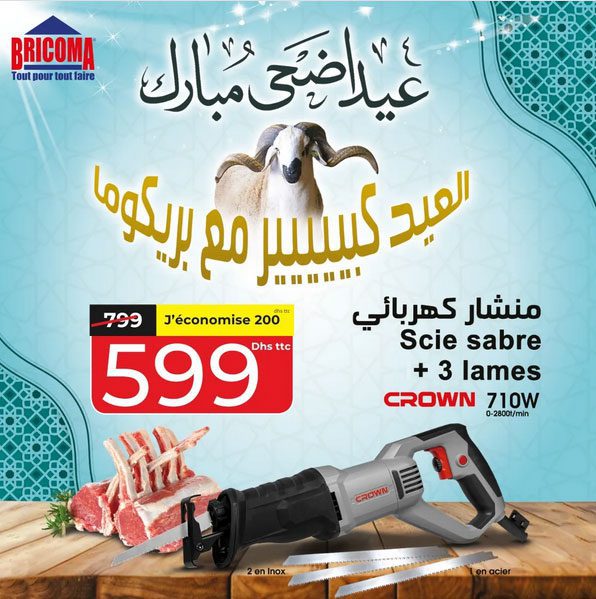
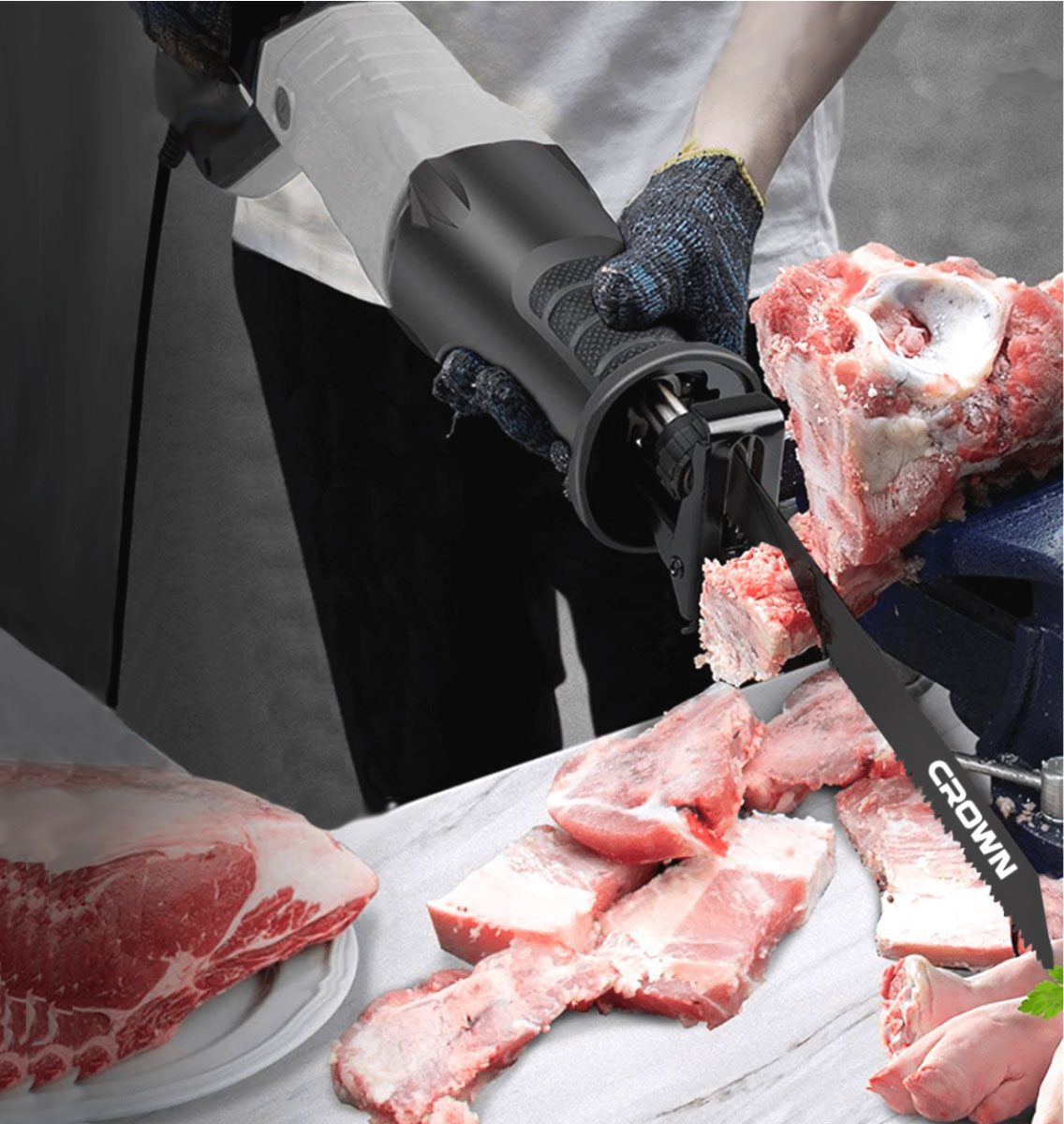
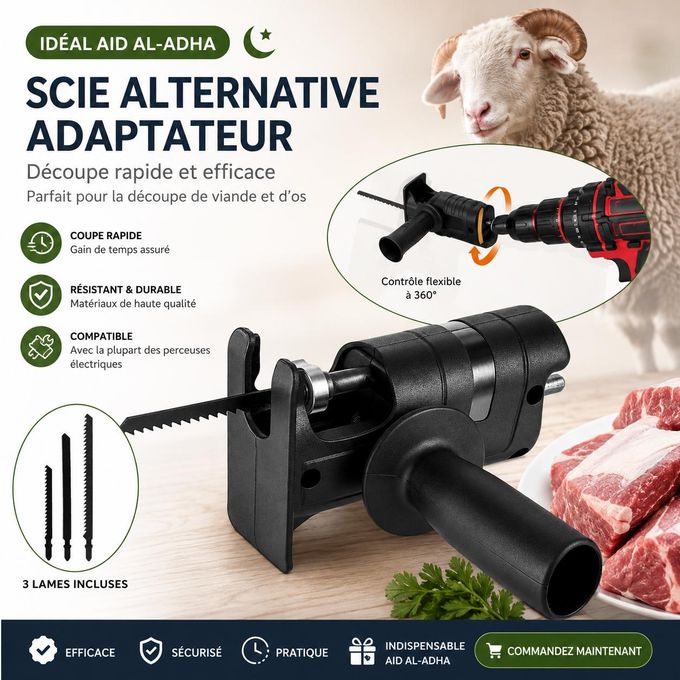
And the reciprocating saw!
If you think a reciprocating saw is just for DIY jobs, cutting up wooden panels, branches in the garden, plasterboard, skirting boards… think again – it’s the amateur butcher’s favourite tool at Eid!
Changes in cultural practices
Hotel stays
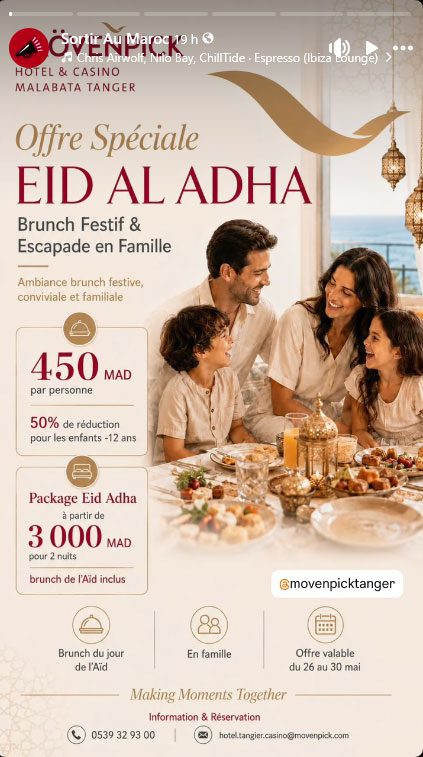
There are also plenty of offers for “holiday” stays in hotels. And in rather luxurious hotels, such as the Mövenpick Malabata. In his column in Tel Quel, Abdellah Tourabi explains that
Buy your lamb on Glovo
The “basic” principle of the sacrifice is that the head of the family symbolically re-enacts Abraham’s sacrifice, slaughtering a sheep in place of his son, whom God had commanded him to kill in order to test his faith.
It is not the meat that matters most, but rather this re-enactment of the father sacrificing a sheep in his son’s place. Moreover, normally, some of the meat is distributed to the poor.
And whilst it is accepted that anyone who is unable or does not know how to perform the sacrifice may have it carried out by another, they are nevertheless expected to be present. This delegation of responsibility, generally accepted in Islam, is nevertheless viewed with particular reluctance by the Maliki school, specific to Morocco, as certain traditions deem it insufficient when the person performing the sacrifice is able-bodied.
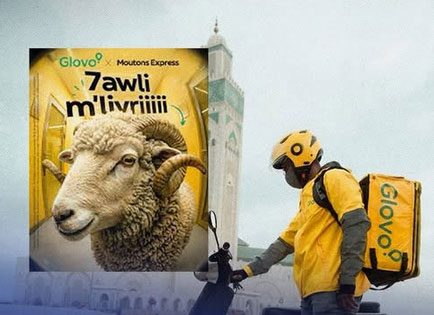
Together with its partner “Mouton Express” (a name you couldn’t make up), Glovo is stripping Eid of its spiritual significance and turning it into a mere act of consumption – a move against which the Grand Mufti of Dubai has protested, warning that mixing the sacrifice with commercial motives completely invalidates this act of worship. The Grand Mufti invoked the prophetic hadith stipulating that not even the butcher should be paid from the meat itself, a principle indicating that no part of the sacrifice may be used as a commercial commodity. The fact that a Grand Mufti felt compelled to intervene shows just how much the situation has deteriorated throughout the Arab world.
Eid Moubarak Saïd !
More information
- Commodified Sunnah: Glovo and the Capitalist Capture of Eid Al-Adha
- An article in English on the "modernisation" and the emergence of Capitalism 2.0 in the celebration of Eid al-Adha
- Inside Morocco’s ‘Fraqchia’ Crisis and the Billions That Failed Consumers
- An article in English that explains the mechanisms of price speculation and the cost to the state
 A typo or syntax error? You can select the text and hit Ctrl+Enter to send us a message. Thank you! If this post interested you, maybe you can also leave a comment. We'd love to exchange with you !