Because the lunar months are determined by sightings of the crescent moon, which take precedence over astronomical calculations, the dates of religious holidays are only known with certainty at the last minute.
Observation of the moon takes precedence over astronomical calculation
Astronomical calculations provide a plausible date, which must be confirmed by observation. If observation is not possible due to weather conditions, then the lunar month is considered to have a maximum of thirty days, and the date of the public holiday is determined accordingly.
This is what happened on the 1st of Muharram, the Hijri New Year ( رأس العام الهجري , ras el haam al hijiria, Hijri New Year), this year. Astronomical calculations indicated that it would fall today, Tuesday 16 June, but the ‘probability of sighting’ was only 60 per cent.
It was on Monday at around 10 pm that the Ministry of Habous announced that it had not sighted the crescent moon and that, as a result, the New Year would fall on Wednesday. And so we would be going to work this morning.
As with the start and end of Ramadhan, and as with Eid al-Adha. However, the date of Ashura, which falls in the middle of the month, on the 10th of Muharram, is known with certainty once the 1st of Muharram is known. This year, it will be on 26 June. But Ashura is not a public holiday!
In practice, appointments are arranged with an option such as ‘if it’s Tuesday, we’ll meet on Wednesday; otherwise, on Tuesday’, or simply postponed until the first day we know for certain we’ll be working (in our case, Thursday).
Celebrating the Islamic New Year in Morocco
Whilst strict adherents argue that Ras El Ham is not a religious festival and therefore need not be celebrated, in practice, Moroccans do celebrate it.
It is a family celebration when people visit their loved ones. The festive meal consists of couscous with kaddid ( قديد ), the dried mutton from Eid, or a mrouzia ( مروزية ), a sweet-and-savoury tajine also made with mutton from Eid, which is also prepared the day after Eid.
The Islamic New Year is also one of the occasions on which one may pay zakat ( زَكَاة ) al-Maal, this ‘legal almsgiving’ which is one of the pillars of Islam.
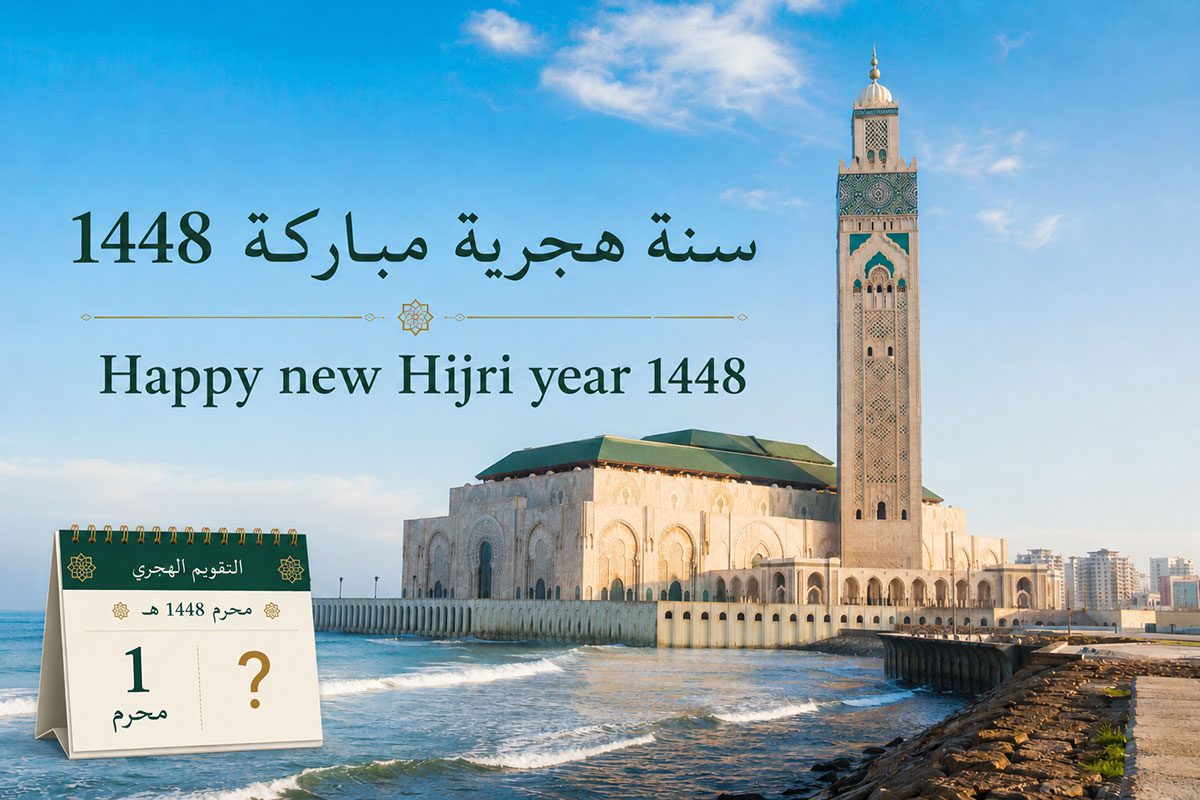
And we would like to wish you a Happy Islamic New Year 1448:
كل عام وأنتم بخير بمناسبة السنة الهجرية الجديدة 1448
 A typo or syntax error? You can select the text and hit Ctrl+Enter to send us a message. Thank you! If this post interested you, maybe you can also leave a comment. We'd love to exchange with you !