The moussem is a festival.
If there is anything comparable to a Moroccan moussem, it is the pardon of the Bretons: a celebration that is primarily religious, to honour a saint, a Sidi, a marabout, but also simply a celebration, and since people have gathered together, sometimes travelling from far away, a fair, trade, exchanges.
Small, limited to a single village, or very large, having gained international renown, such as the engagement moussem in Imilchil or the moussem of the Valley of Roses, moussems follow one another, mainly in southern Morocco, linked to the tradition of the zawiyas, some of which had an immense influence throughout the Arab world.
Zawiya, Sidi, Marabout, the ‘patrons’ of the moussems
The zawiya is a Sufi spiritual centre where spiritual practices are carried out and where the founding saints of the brotherhood that occupies the centre are buried. It was founded by a respected religious man, a Sidi, who is celebrated in a moussem. The Sidi may have lived in several places and founded several zawiyas. His moussem is an opportunity to strengthen ties between these different villages, each of which sends representatives and gifts.
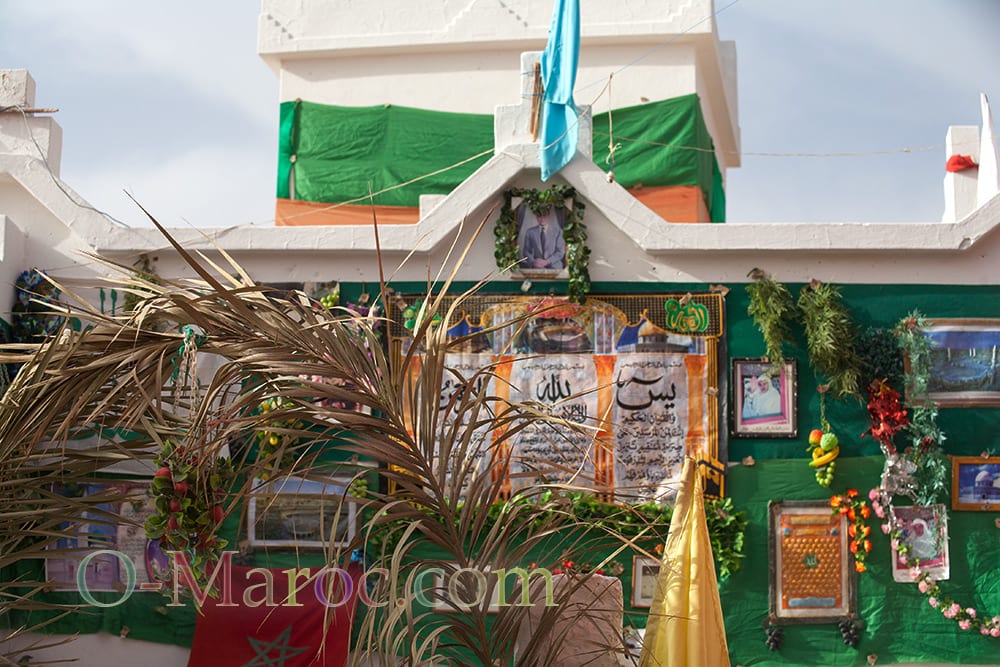
This Sidi can also be a marabout, very often (but not necessarily). A marabout is a man of faith to whom God has given powers, which he manifests by performing miracles, causing springs to gush forth, and healing the sick. Buried in a monument that is called, by extension, a marabout, he continues after his death to protect his community and even to perform miracles.
A distinctive feature of southern Morocco is the presence of numerous “Jewish marabouts“, who are revered by both Muslims and Jews. Some moussems are specifically Muslim or Jewish, but others, though rarer, bring together both communities.
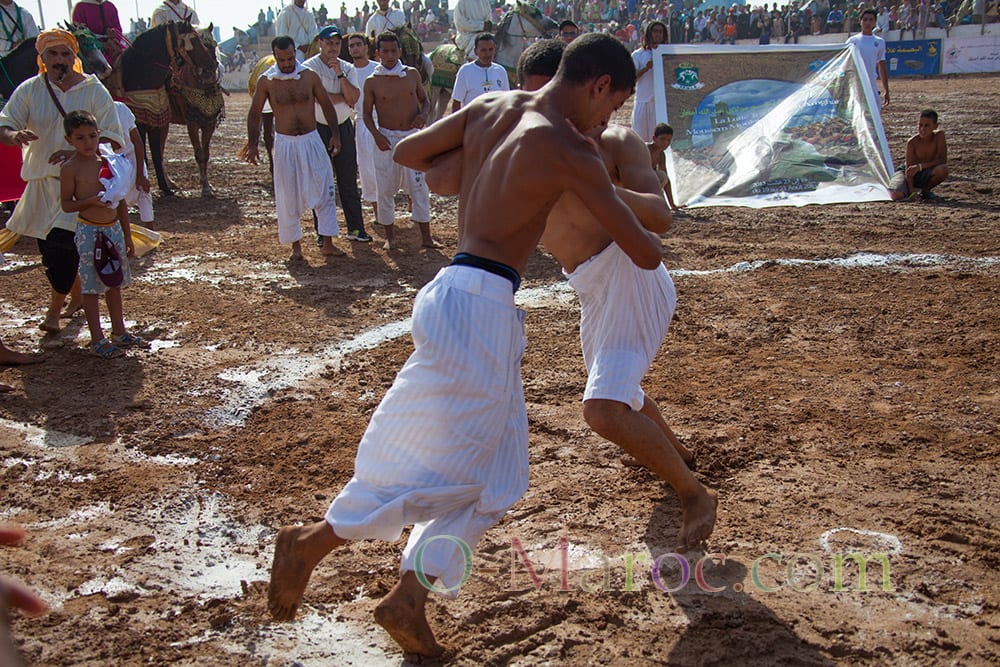
The third reason for holding a moussem is simply to celebrate. These celebrations are often linked to agricultural cycles, harvest festivals, such as the Date Festival in Erfoud, the Rose Festival in Kelaa T’MGouna, or large fairs, such as the Imilchil engagement moussem, which is accompanied by a huge camel souk.
For all these formerly nomadic populations, the moussem is an opportunity, sometimes the only one in the year, to get together, exchange news, strengthen family ties, find a spouse, in short, to feel part of the community. And for sedentary people, it is also an opportunity to meet all those who live far away and are rarely seen.
Beyond these traditional celebrations, more modern ‘moussems’ have flourished, simple cultural events such as the Symphonies of the Desert in Ouarzazate, the Fantasia festival in Meknes, or the Essaouira Gnaoua Festival. These events are of high quality and offer the best in Moroccan culture.
What happens during a moussem?
A religious celebration
Often inaccessible to non-Muslims, it takes place either at the mosque or in the marabout of the Sidi. There may be a sacrifice, such as a sheep or, as in Tazzarine, a camel. There may also be dancing and trances. And generally, alms are distributed.

There may also be recitations from the Qur’an. Recitations are very popular, with Moroccan television regularly organising competitions (in which both girls and boys participate), and this is also reflected in the moussems.
Dances, songs, poetry
Whether spontaneous or in the form of a parade, on street corners or on stage, songs and dances are at the heart of a moussem. Depending on the region, you may see an ahaouache, the sword dance or the bee dance, a group of Gnaouas, or a Taskiwine…
The ahaouache and the hahidous are the traditional dances of the Berbers throughout the South and Middle Atlas. The women, dressed in their finest clothes, silk scarves and heavy silver and amber jewellery, form a large circle and dance to a rhythm created by the men, who gather in the centre of the circle with heavy tambourines. The group is led by a Raïs. Other variations exist, where women and men dance face to face, or in two circles that surround each other without mixing. And there are as many variations as there are douars.
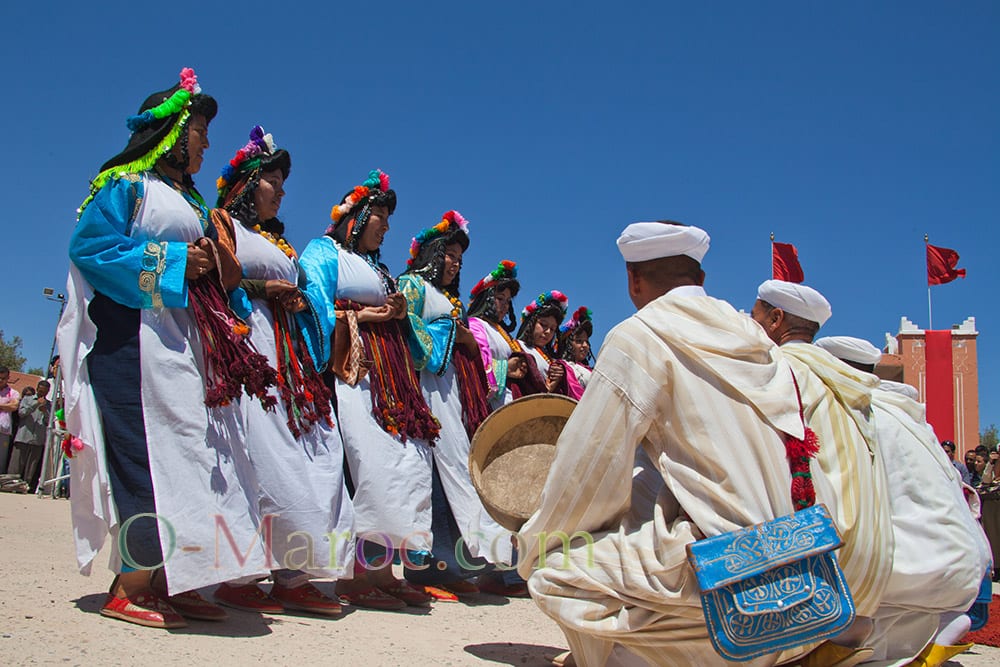
The ahwash of Kelaa M'Gouna is called the dance of the bees.
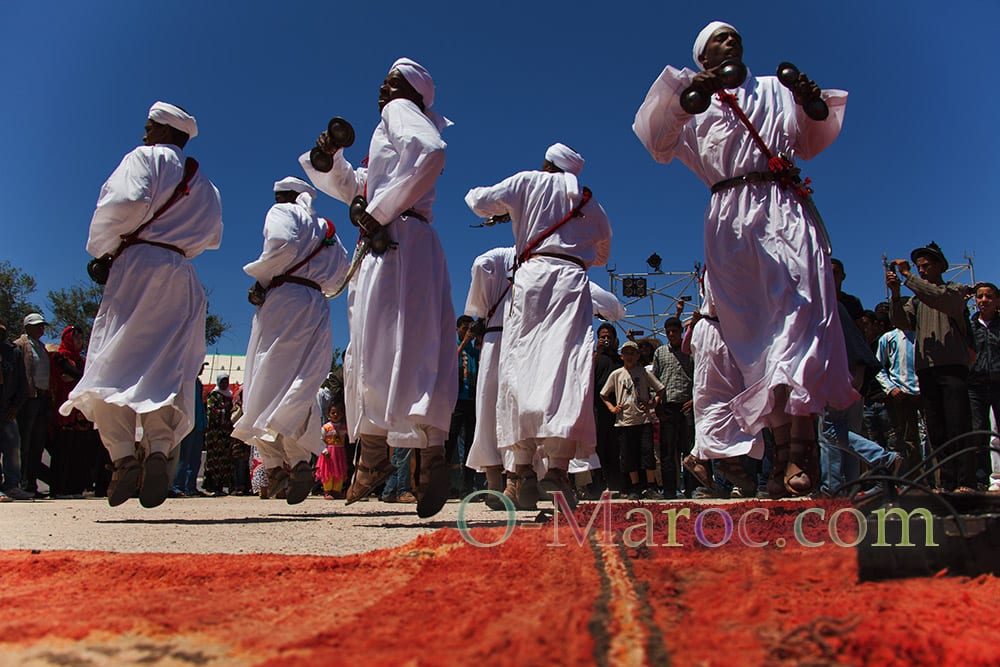
The Sabre Dance comes from the region of Zagora, where two dancers, accompanied by musicians, mimic a fight. Another war dance is the Taskiwine, or the art of shaking one’s shoulders to the rhythm of the Taârijas (tambourines). The men wear their powder horns and red shoulder straps and move to the rhythmic steps.
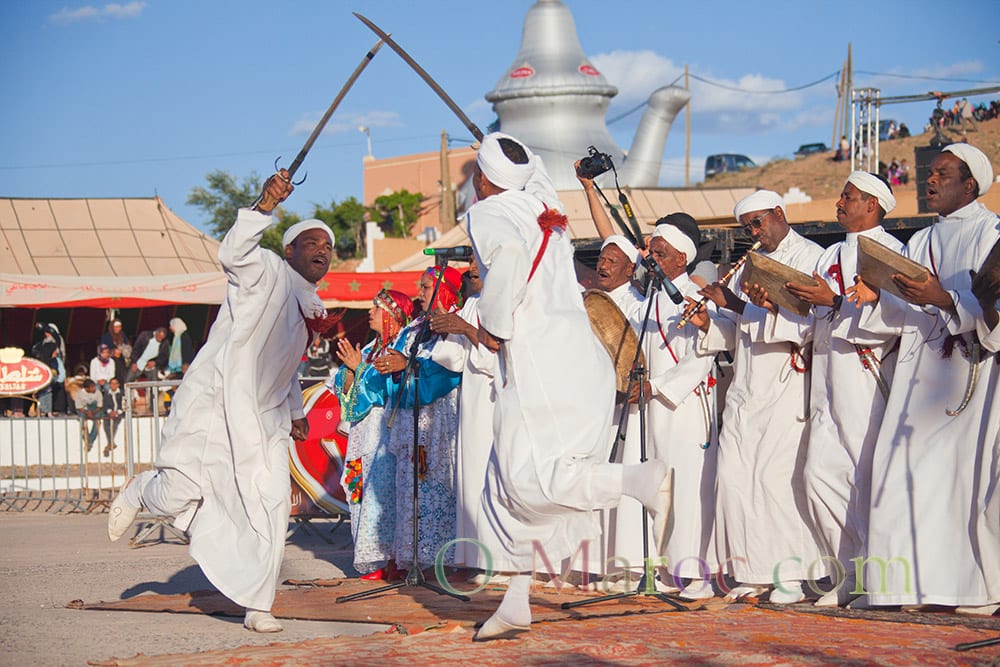
Finally, there is a group quite apart from the others, the Gnawas, descendants of former black slaves. They set the dance floor alight with the Hajhouj, the Tbel and the Graquebs. They dance the Kuya and sing in an Arab-African dialect, invoking saints and spirits. Their dance and percussion evoke their suffering, bent under the weight of their chains. They are believed to have mystical powers, and their music can put you into a trance.
Trading
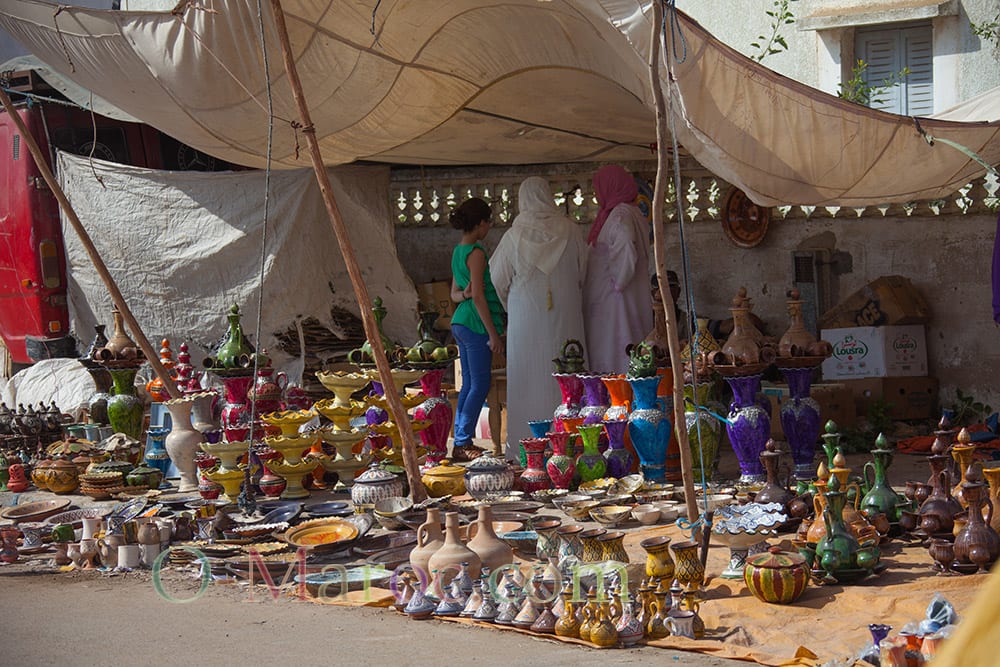
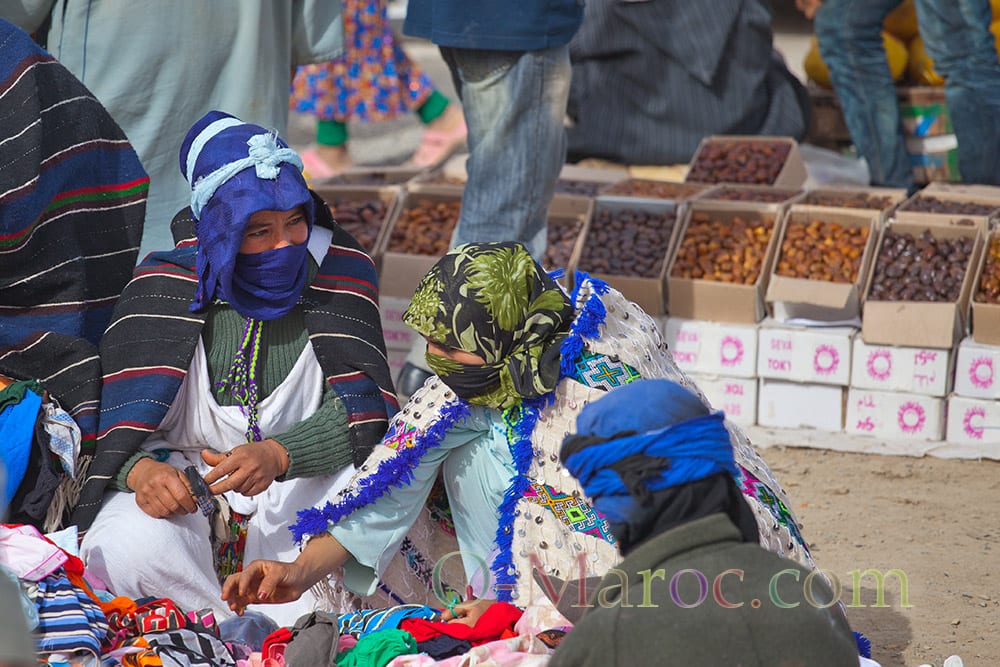
For all the moussems, which are ‘harvest festivals’ (moussem of roses, dates, moussem of Taliouine, etc.), the souk is at its busiest. Everyone has been able to sell their harvest and has full pockets to buy whatever they want. Merchants flock to the souk, and women set up stalls to sell scarves, jewellery and beauty accessories. You can spend hours strolling through the streets.
 A typo or syntax error? You can select the text and hit Ctrl+Enter to send us a message. Thank you! If this post interested you, maybe you can also leave a comment. We'd love to exchange with you !