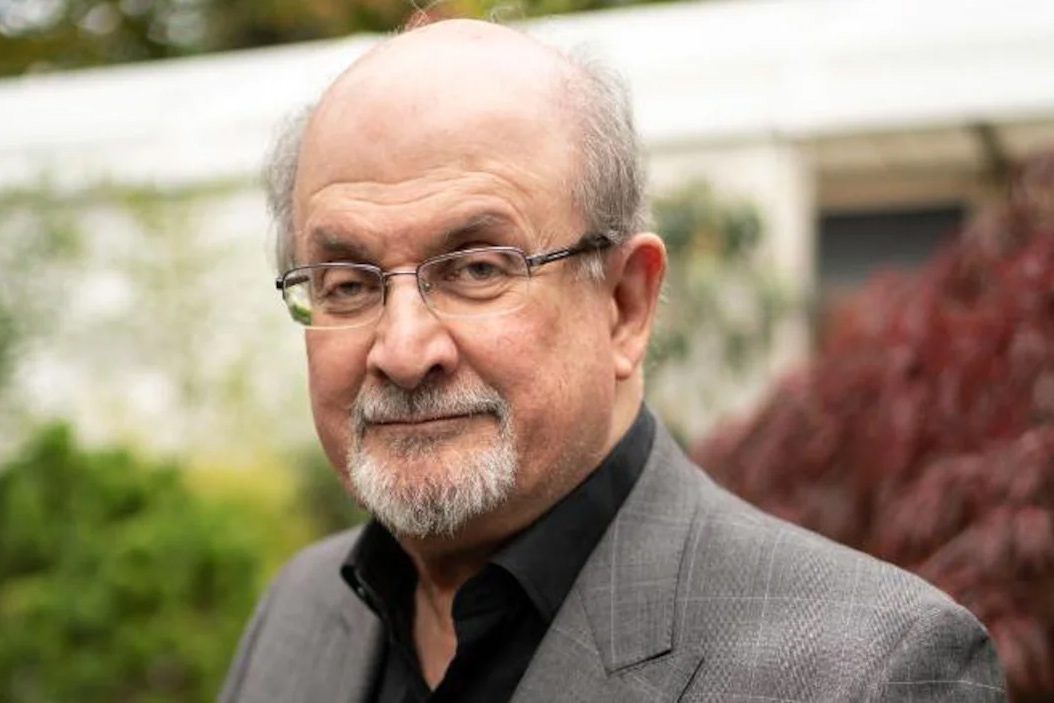
Clearly, a number of ‘youngsters’ or millennials don’t really have a clear idea of who Salman Rushdie is and why a number of Iranian mullahs have been harbouring such hatred towards him – and towards his translators and publishers – for 34 years now.
Between the “Who’s that?”, “This book’s a bit of a bore, isn’t it?” and “It’s just a publicity stunt” comments I’ve seen on Twitter, I’ve decided, for once, to stray from O-Maroc’s main topic.
Sometimes you can stray from the straight and narrow.
And because I’m extremely surprised that not all the champions of freedom of expression have changed their profile picture to ‘I am Salman’. One could, if one were being cynical – which is never my style – see this as an expression of a certain kind of racism, suggesting that, after all, the ‘Muzzies’ (ironically, need I remind you?) can slaughter one another without it being a problem…
Anyway, that’s not the main point.
Who was Salman Rushdie before *The Satanic Verses*?
Born in 1947 in Bombay to an Indian family originally from Kashmir, Salman Rushdie is a British writer who was educated in India and England, at King’s College, Cambridge (a rather posh place…). His father had chosen their surname in honour of Averroes (Ibn Rochd in Arabic) and had also studied at Cambridge.
He worked in advertising and published his first novel, *Grimus*, in 1975, with the lack of success typical of debut novels.
Midnight Childrens
On the other hand, his second novel, *Midnight Children*, is a massive hit.
Published in 1981, it won the highly prestigious Booker Prize and the James Tait Black Memorial Prize from the University of Edinburgh. In 1993 and 2008, it was named ‘Book of the Booker‘ to mark the 25th and 40th anniversaries of the Booker Prize. Finally, it is the only Indian book to feature on Time magazine’s list of the 100 best novels written in English between 1923 and 2005.
The book has sold over a million copies and marks a milestone in the history of Indian literature: the years following its publication saw many novels drawing inspiration from it, and are referred to as the ‘post-Rushdie years’.
The Rushdie ‘style’: magical realism and political metaphors
His style – or rather, his world – is distinctive; it blends dreams, fiction and reality in a world that is not quite our own. Magical realism allows Rushdie to explore modern history whilst transforming it, and to draw on historical figures without having to remain faithful to historical reality.
The Satanic Verses, a complex novel
In other words, Rushdie was already a great writer who had no need to seek publicity (as I saw on Twitter) when he published *The Satanic Verses* in 1988.
Its title derives from a controversial Muslim tradition (an unreliable hadith), which states that Muhammad initially recited verses acknowledging three goddesses from the pre-Islamic era who were said to have been worshipped in Mecca, but later withdrew them, explaining that they were the work of Satan. This tradition was recorded by Attabari; it therefore predates Rushdie’s book by a considerable margin. In the Arab world, these are referred to as the ‘Gharani’ verses; the term ‘Satanic Verses’ is a Western one.
What is different in Rushdie’s book is that, according to him, these so-called ‘Satanic Verses’ were, like the genuine verses, revealed by the Archangel Gabriel.
In essence, if you are not familiar with the elements to which magical realism refers (Indian history, the Muslim faith), the book becomes obscure, verging on boring.
But like many others… Joyce’s *Ulysses*, Proust and Céline are writers ‘for intellectuals’.
The shocking elements
Apart from the title, there are other elements that are equally shocking:
- the use of the medieval name ‘Mahound’ to refer to the Prophet, which is said to mean ‘the false believer’ or something similar
- the use of the name Jahiliyyah (the pre-Islamic ‘Age of Ignorance’) for the city of Mecca, where a brothel had prostitutes bearing the same names as the Prophet’s wives (which are, after all, the most common names given to girls in the Muslim world)
- the fact that a film star is called Gabriel, like the archangel
- the use of the name Saladin for a demon (though this is outside the realm of religion)
- the use of the name of one of the Prophet’s wives for a fanatical Indian woman who leads her village on a fatal pilgrimage (like the Children’s Crusade)
- calling Abraham a bastard (what’s up with your mum?) for sending Hagar and Ishmael into the desert
- giving Muhammad (Mohand in the book) some rather un-halal visions on his deathbed
Or a statement:
The fact is that religious faith, which embodies the highest aspirations of the human race, is now, in our country, the servant of the basest instincts, and that God is the creature of evil…
“Over here”, we started out as Protestants for the same reasons… and, in a way, even as Christians (cf. the reference to the Pharisees’ whitewashed tombs).
Controversies and fatwas
As soon as it was published, the book provoked the anger of “some” Muslims, much to Rushdie’s surprise, as he had not expected such outrage. The fact that the author is of Muslim origin is, of course, a factor, even though Rushdie describes himself as an atheist. Be that as it may, its import was banned in India barely a month after its publication, and very soon afterwards in Pakistan, Iran and elsewhere.
Which means that the thousands of people who are protesting angrily and calling for Rushdie to be killed have never read the book.
However, we are talking about a chapter in which Rushdie deliberately used the name Mahound so as not to refer to the Prophet, but rather to an allegory.
In fact, that is exactly what he himself says:
To be honest, I would have liked to have written a more critical book. […] I am very sad that this has happened. It is not true that this book is blasphemous towards Islam. I very much doubt that Khomeini or anyone else in Iran has read the book, or anything more than selected extracts taken out of context. [… ] A religion whose leaders behave in this way could probably do with a bit of criticism.
What happened next is well known: a death sentence handed down by Imam Khomeini on 14 February 1989, which has never been revoked and was renewed by other imams following Khomeini’s death; a reward of several million dollars in this world, in addition to the 72 virgins in Paradise; and Al-Qaeda adding Rushdie’s name to its list of targets (alongside Charb, *Charlie Hebdo* and Ayaan Irsi Ali).
Rushdie is forced to go “underground” (a perfectly official form of going underground, of course), changes his name, and lives in constant hiding, under police protection. His publishers and translators are harassed; his Japanese translator is even killed.
In 2022, more than 33 years after the first fatwa, it seems he will escape death.
And I’m going to go back to reading “The Tribulations of the Last Sijilmassi” by Fouad Laroui (yes, really, it’s relevant and ties in with Morocco). Unfortunately not translated in English…
 A typo or syntax error? You can select the text and hit Ctrl+Enter to send us a message. Thank you! If this post interested you, maybe you can also leave a comment. We'd love to exchange with you !