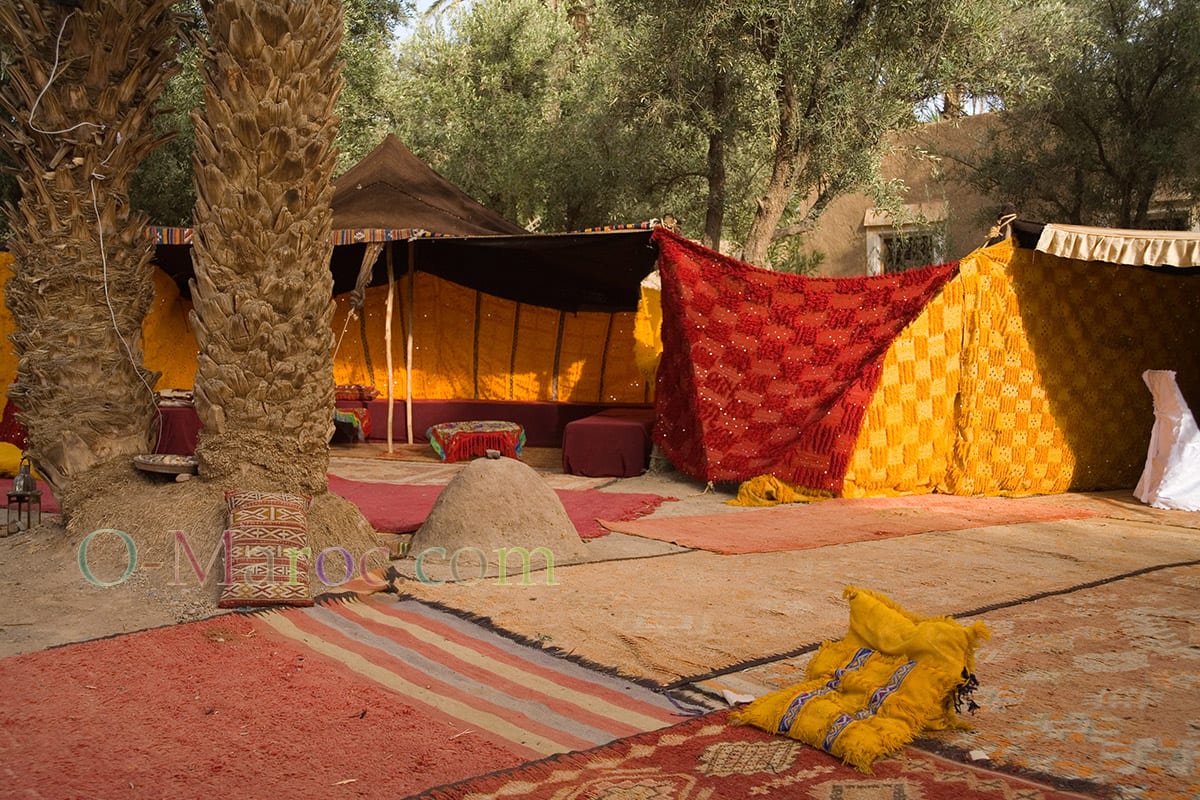
The tent is called ⴰⵅⴰⵎ in classical Tamazight (Central Atlas) and ⵜⴰⵅⴰⵎⵜ (takhamt, feminine) among the Aït Yafelman (the eastern confederation, which includes, for example, the Aït Moghad of Goulmima).
The large nomadic tent is made of wool, either goat or camel, and usually lasts for several seasons. This is primarily because a lot of wool is required, and it also takes time. The looms are quite narrow, and long strips are woven and then sewn together side by side.
The ‘people of the tent’ are the family unit.

The walls are made either of the same wool or of fine, tightly woven white cotton.
For permanent camps, carpets are sometimes used, which are more windproof but much heavier.
When it rains, the wool expands and the roof quickly becomes watertight. A wet tent is heavier and more fragile, and sometimes it is better to take it down than risk losing it.
Similarly, when there is a sandstorm, the tent suffers greatly, but it is a valuable shelter.
The best thing is to see the stars at night through the wool roof.
In Arabic, a tent is called khayma or khaïma.In Arabic, a tent is called khayma or khaïma.
 A typo or syntax error? You can select the text and hit Ctrl+Enter to send us a message. Thank you! If this post interested you, maybe you can also leave a comment. We'd love to exchange with you !