That happened 114 years ago.
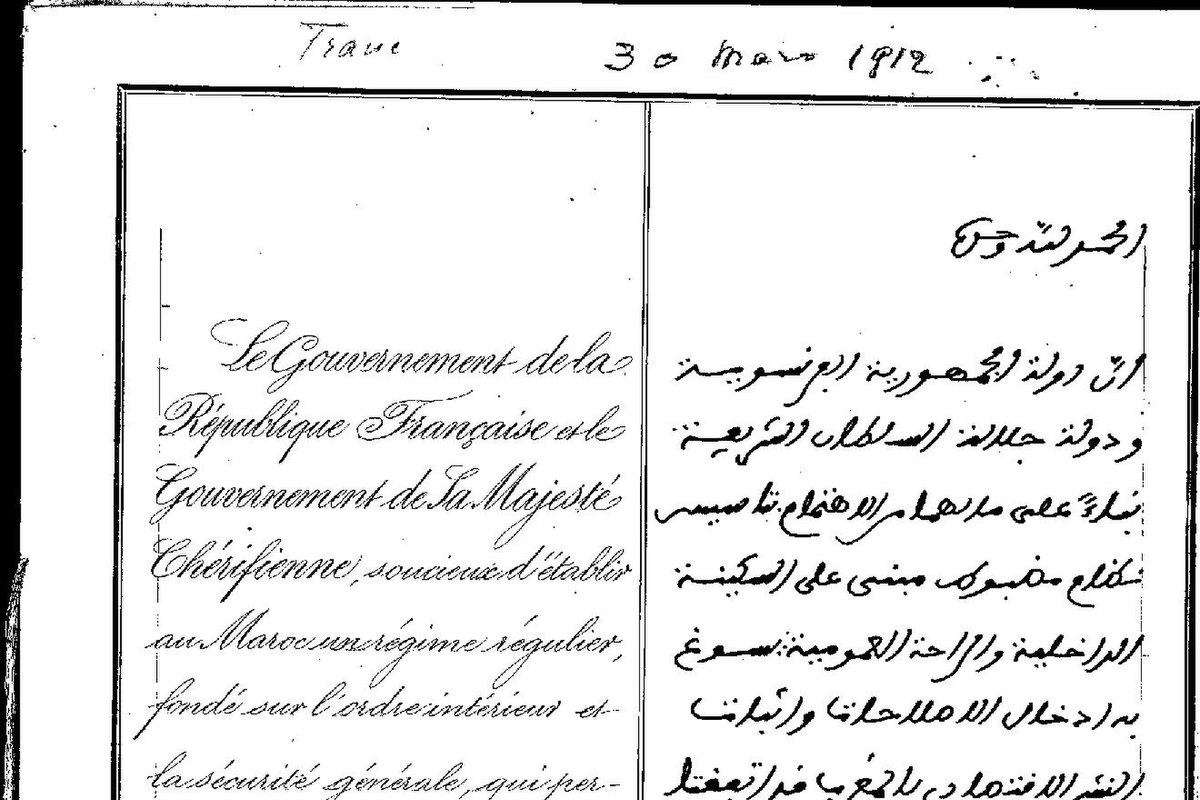
Concluded in Fez on 30 March 1912 for the “organisation of the French protectorate within the Cherifian Empire”, and signed by Sultan Moulay Abdelhafid on behalf of Morocco and by Eugène Regnault, diplomat and Minister Plenipotentiary for France, this treaty divided responsibilities between France and Morocco for the administration of the country.
His text shows that the term ‘protectorate’ actually refers to the almost complete takeover of the country’s administration, a far cry from the idea that France would be responsible only for foreign affairs.
As a reminder, the difference between a colony and a protectorate, according to the French Foreign Office:
Preamble to the Treaty of Fez
The Government of the French Republic and the Government of His Majesty the Sultan, desirous of inaugurating a regular regime in Morocco based upon internal order and general security, making it possible to introduce reforms and to insure the economic development of the country, have agreed upon the following:
Article 1 of the Treaty of Fez
The Government of the French Republic and His Majesty the Sultan have agreed to establish in Morocco a new regime admitting of the ad- ministrative, juridical, educational, economic, financial and military reforms which the French Government may deem useful to be intro- duced within the Moroccan territory.
This regime shall safeguard the religious status, the respect and traditional prestige of the Sultan, the exercise of the Mohammedan religion and of the religious institutions and in particular those of the habous. It shall admit of the organization of a reformed Shereefian makhzen.
The Government of the Republic will come to an understanding with the Spanish Government regarding the interests which this government has in virtue of its geographical position and territorial possessions on the Moroccan coast.
In like manner, the City of Tangiers shall retain the distinctive characteristic for which it has been known and which will determine its municipal organization.
Article 2 of the Treaty of Fez
His Majesty the Sultan consents that henceforth the French Government, after it shall have notified the makhzen, may proceed to such military occupation of the Moroccan territory as it might deem necessary for the maintenance of good order and the security of commercial transactions, and to exercise every police supervision on land and within the Moroccan waters.
Article 3 of the Treaty of Fez
The Government of the Republic pledges itself to lend constant support to His Shereefian Majesty against all dangers which might threaten his person or throne, or endanger the tranquillity of his states. The same support shall be given the heir to the throne and his successors.
Article 4 of the Treaty of Fez
Such measures as the new regime of the protectorate may require shall be edicted, upon the proposal of the French Government, by His Shereefian Majesty or the authorities to whom he may have delegated his power. The same process shall be observed in the matter of new regulations and of modifications to the existing regulations.
Article 5 of the Treaty of Fez
The French Government shall be represented near His Shereefian Majesty by a resident commissioner general, representative of all the powers of the republic in Morocco, who shall attend to the execution of the present agreement.
The resident commissioner general shall be the sole intermediary of the Sultan near foreign representatives and in the relations which these representatives maintain with the Moroccan Government. In particu- lar, he shall have charge of all matters relating to foreigners in the Shereefian Empire.
He shall have the power to approve and promulgate, in the name of the French Government, all the decrees issued by His Shereefian Majesty.
Article 6 of the Treaty of Fez
The diplomatic and consular agents of France shall be charged with the representation and protection of Moroccan subjects and interests abroad.
His Majesty the Sultan pledges himself not to conclude any act of an international nature without the previous approval of the French Republic.
Article 7 of the Treaty of Fez
The Government of the French Republic and the Government of His Shereefian Majesty reserve unto themselves to determine by mutual agreement the bases for a financial reorganization which, while respect- ing the rights conferred upon bondholders of the Moroccan public loans, shall make it possible to guarantee the engagements of the Shereefian treasury and to collect regularly the revenues of the empire.
Article 8 of the Treaty of Fez
is Shereefian Majesty declares that in future, he will refrain from contracting, directly or indirectly, any public or private loan, and from granting in any form whatever any concession without the authorization of the French Government.
Article 9 of the Treaty of Fez
This Convention shall be submitted to the Government of the French Republic for ratification, and the instrument of ratification shall be delivered to His Majesty the Sultan at the earliest possible opportunity. In witness whereof, the undersigned have drawn up this instrument and affixed their seals thereto.
A text that grants France very broad powers
When compared with the text of the Treaty of Bardo, which established the protectorate of Tunisia in 1881, the Treaty of Fez is far more precise, far more detailed and grants France far greater powers. Although Muslim institutions are not placed directly under French authority, the mechanism of decrees ‘proposed’ and ‘promulgated’ by France effectively places them under its control.
“The sultan’s traditional respect and prestige” are preserved, but not his authority.
 A typo or syntax error? You can select the text and hit Ctrl+Enter to send us a message. Thank you! If this post interested you, maybe you can also leave a comment. We'd love to exchange with you !