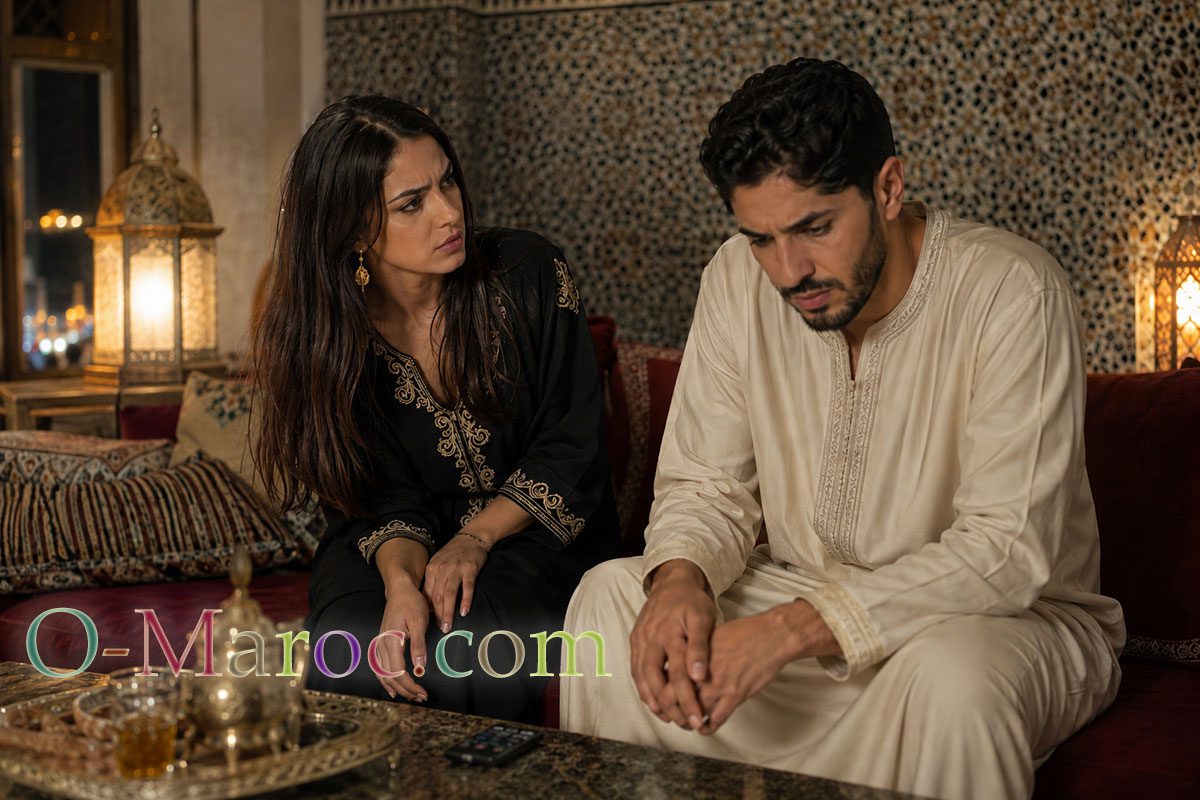
Some thoughts on [myurl slug=”llnfl_mariage_mixte” anchor=”mixed marriages”]
For non-Arabic speakers, this sentence means “Where are you, and who are you with?”
It was practically one of the first phrases my Arabic teacher, who was from Taza, taught me.
She said it in a rather curt, threatening tone, as if to say, “You’d better tell me who you’re hanging out with, and quickly.”
We used to laugh it off, but for me it has become the motto of a jealous or anxious Moroccan woman.
In a country where, as soon as you step outside ‘modernised’ circles, segregation between men and women is almost total, where a woman cannot be alone with a man, even on a café terrace, and where parties and celebrations are strictly gendered, men go out with their mates on one side, women with theirs on the other; often only men are invited, or only women, and when both are invited, they end up in two separate rooms – it’s a phrase we often hear.
A touch of normal curiosity, or, on the contrary, an inquisitive and jealous one.
In days gone by, in a time that no longer exists, of course, when a woman had no legal protection, when her husband could quite legally take a second wife, without even going to court, and without his first wife knowing, this question was far less innocent than it seemed. The women’s circle sought to breach the wall of the men’s circle, to find out what the husband was doing, who he was seeing, before it was too late, before he had met a scheming woman.
Beyond mere questions, a woman might also resort to magical practices, go to the fquih, be given herbs, or have a spell cast that would then be ‘bound’ for added security, by a marabout whose power could hold the man in check.

And sometimes, as happens everywhere, people took the plunge; the herbs served a purpose other than simply keeping one’s husband in line—the one you’d ask, “Fink, maa men”—the herbalist became something of a poisoner, and the husband fell ill, or worse.
What struck me in Morocco was the mistrust in male-female relationships.
The Amitié Homme Femme, relationships between a man and a woman, if they go beyond the realm of the innocuous and the everyday—particularly in the workplace—are inevitably viewed through a sexual lens, in the context of seduction, and are either sought after or, conversely, avoided by any means possible.
And with that comes mistrust.
Firstly, mistrust of the other person, quite simply: girls are said to be seeking marriage at any cost, whilst boys are said to be looking only to take advantage, without fulfilling their obligations.
And then, as we all know, don’t we, when an unmarried man and woman are alone together, the devil always invites himself in as the third wheel?
Mistrust also within the couple, of what the other might do one day; that constant jealousy, which is also seen as normal, as honourable, as proof of love. I had quite an interesting discussion on a blog, where we came to the conclusion that the Arabic feeling of ‘jealousy’ cannot be translated into its French equivalent. Or perhaps by referring to a meaning it has since lost, but which is found in classical French—that of, for example, the gentleman jealous of his honour.
It also seems to me that the search for a foreign partner is also a search for a partner who does not have these traditions. For both men and women, this allows them to let down their guard against mistrust. In any case, that is what I have often understood to be the motivation of the people around me who admit to looking for “a European woman”.
In this sense, the Moudawana – which is becoming less and less of a novelty – represents a major step forward, by empowering women to achieve greater independence. This makes it possible to return to a relationship based on love, rather than on self-interest or the fear of ending up alone and destitute. But it takes time.
In the meantime, when my husband has spent a whole day out and about, and I ask him in the evening what he’s been up to, who he’s seen… I always hear that “fink maa men” which makes us both laugh.
PS: part of this article is humorous and exaggerated. And I also know that the majority of Moroccan couples are close-knit and happy – do I really need to say so?
Eighteen years on, the jealousy and mistrust are still there
This article was published in 2008 on Casawaves, a blog run by Laurent Bervas that discussed Morocco with passion.
Amidst three or four articles on ‘business’ and new technologies, every now and then an article like this (or others) would spark lively discussions.
What I’ve seen over the years on Facebook groups confirms what I was writing back then. Jealousy exists on both sides, sometimes with serious consequences, such as the man who wanted to divorce his wife because one evening, at the end of the day, a male colleague had driven her home.
Yet, Fink maa men has changed in nature. Today, this surveillance is becoming increasingly indirect, via phones and apps; infidelity is becoming increasingly virtual, and so is control. Dual profiles, locked phones… the whole arsenal of the web for communication and surveillance 2.0
 A typo or syntax error? You can select the text and hit Ctrl+Enter to send us a message. Thank you! If this post interested you, maybe you can also leave a comment. We'd love to exchange with you !