
It’s the latest buzz, and dog owners who aren’t well informed are panicking, because it seems that the government has passed a law “to exterminate dogs in Morocco”.
This is totally false, exaggerated and distorted.
Having a dog in Morocco
Today, there are four types of dog in Morocco:
C’est le dernier buzz, et les propriétaires de chiens qui ne sont pas bien informés s’affolent, car, parait-il, le gouvernement aurait fait passer une loi « pour l’extermination des chiens au Maroc ».
C’est totalement faux, exagéré et déformé.
Avoir un chien au Maroc
Today, there are four types of dog in Morocco:
- stray dogs, which can be quite aggressive, even dangerous, and can easily be contaminated with rabies (rabies is endemic in Morocco)
- working and guard dogs, many sheepdogs, dogs in large villas, companies, warehouses, etc. They are not particularly well cared for (vets don’t know), but they are domesticated and controlled, and their potential for aggression towards humans is equivalent to that of a country dog in France
- “companion” dogs, of which there are two types: real companion dogs, or pets, which are very rare and more likely to be owned by Westerners, and breeding dogs, which are then sold to hunters, foreigners or as guards
- “show dogs”, bought by young people who use them to go around showing off. Here, in El Jadida, it’s along the beach, in the evening, in this article, it’s in Fez, in a wasteland; the rest of the day, they’re stuck on terraces (and guarding houses); they’re often big dogs, German shepherds, pitbulls or bigger and – it has to be said – their masters don’t know how to train them, there aren’t many dog training courses here, most of the young people are unemployed. These animals are poorly fed (chicken feet are free), not very well treated, and can easily become dangerous if they get away from their master.
Moroccans aren’t comfortable with dogs
Apart from farmers and nomads, who are used to working with dogs, Moroccans are not at ease with pets, and even less so with dogs.
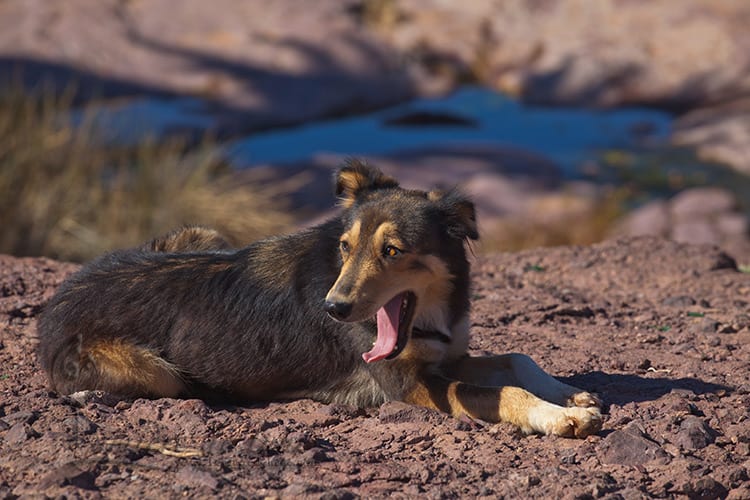
According to Islam, a dog is an impure animal. If you touch it before praying, you must perform the great ablutions. And it must not be allowed to enter a house, as it would chase away the angels (obviously the city dog arrives on the terrace miraculously, without “entering the house”).
So Moroccans are not used to being in close contact with dogs, don’t know how to react to a threatening animal (except by throwing stones at it) and are, as a general rule, genuinely afraid of them. And the Atlas dog, a common sight here, is a rather large beast that inspires caution.
This fear is compounded by the growing number of stray dogs.
The law on dangerous dogs
The law on dangerous dogs was apparently inspired by French law. It is NOT a call for the extermination of dogs, as has been said, nor is it a sign of nameless barbarity.
I still don’t understand what could have provoked such hysteria…
What does the law say? Here’s a summary of the text (you can download the pdf of the bill on dangerous dogs).
Dangerous dogs
A dangerous dog is a dog whose breed is distinguished by aggressiveness that presents a danger to humans.
Distinguished means more than the others. Cocker spaniels are not distinguished from others.
Aggressiveness means a habitual type of behaviour. A Saint Bernard is not aggressive.
Danger to humans, that’s clear too… a Chihuaha is not dangerous.
The list will be drawn up by decree.
A priori, the breeds concerned would be: Pittbulls, Rottweilers, American Staffordshire, Argentine Mastiffs, Cane Corsos and Great Danes.
The ownership, possession, acquisition and breeding of these dogs is prohibited. Now, for the owners of the dogs on this list (which we still don’t know…), this is going to cost in baksheesh. And they won’t be able to show them off in town.
But I’ll be honest: I love dogs (less than cats… but still), and I’m particularly fond of big, fat dogs. A friend of mine had a Naples mastiff, a kind of debonair calf. However, there are indeed breeds that have been hyper-selected for their aggressiveness. Why take a risk? Why turn to these breeds and not others? When, in Morocco more than anywhere else, the pedigrees, the quality of the breeding (and therefore the impregnation of the puppy) are not safe?
(Incidentally, in the article listing the breeds, one dog owner claims that her rottweiler defended her… against the neighbor’s rottweiler, which had escaped through the open door!)
It’s like any risk: you think you’ve got it under control until it’s too late. And the 11,000 or 50,000 bites a year (depending on the source) don’t just come from stray dogs!
Les autres chiens
For other dogs, a declaration to the competent authority is compulsory, as is a health record and vaccination against rabies. There was exactly the same law in Germany (dog owners pay taxes) and nobody was shocked. To put it plainly, your dog must be tattooed or chipped (we don’t know yet) and vaccinated.
The owner must keep it on a lead, muzzle it in public, and not let it go rummaging in the derb bins (“ramble”). Muzzling all dogs is a bit harsh… but apart from this detail, the obligations are the same in France.
Trading and breeding are subject to authorisation, and you need to have premises that are in good condition, large enough, professional skills and work with a vet. Nothing shocking?
Dog fighting is banned. That’s good, isn’t it? But dog lovers aren’t bothered….
In the event of a breach of the law on dogs
Dogs CAN be seized by the police (or gendarmerie). In the event of seizure, dangerous dogs will be euthanised, as will dogs that have caused more than 21 days off work.
I don’t know if you’ve ever seen the condition of someone bitten to the point of having twenty-one days off work? It’s very ugly… and very painful.
In other words, yes, if it comes to seizure, the dog will be euthanised. (As in France, it’s how long in the pound before euthanasia). But for this to happen, the dog has to have really been violent.
Because the police have other things to do than look for dogs that don’t get noticed.
And while it’s true that by law, owners of banned dogs are obliged to hand them over to the veterinary services within a month of the publication of the decree (still not published to date), this law will be like many others: in practice, only truly abusive and dangerous cases will be punished.
In a country where more than 11,000 bites are reported every year, this is no luxury!
(The photo of a pit bull used as a thumbnail was taken from this photo by Kathy Doucette, licensed under CC BY NC SA)
 A typo or syntax error? You can select the text and hit Ctrl+Enter to send us a message. Thank you! If this post interested you, maybe you can also leave a comment. We'd love to exchange with you !