

The Villa Majorelle is one of the icons of modern Moroccan design, thanks to its intense blue and the superb setting of the gardens, dotted with splashes of colour.
Morocco is a country with a history stretching back thousands of years, facing both the Mediterranean basin, Europe and the Middle East, and Black Africa. Moroccan caravans have travelled thousands of kilometres over the centuries. Gold, ivory, salt, slaves, jewellery, precious silks…. from the mines of Mauritania to faraway China, trade brought Morocco many sources of inspiration.
Moroccan styles reflect the variety of its populations, with Berber or Arab motifs, the decorative influences of Moroccan Jews, exchanges with Muslim Andalusia, the omnipresence of abstract and geometric motifs, calligraphy…
If Atlas rugs and wedding blankets are so sought-after today, did you know that each tribe has its own patterns and colours, just like Scottish tartans, and that connoisseurs can identify a woman’s tribe by looking at her coat?
Learn more about Morocco and its influences, so that you can appreciate Moroccan decoration to the full, and that’s what we
The Villa Majorelle is one of the icons of modern Moroccan design, thanks to its intense blue and the superb setting of the gardens, dotted with splashes of colour.

A luxurious Moroccan decor without ostentation, comfortable and modernising traditional codes, this is the Bou Saf Saf villa in Marrakesh.

The basic elements of Moroccan decoration blend quite easily with foreign influences, whether modern or Asian, for example. Decorators regularly draw inspiration from them.
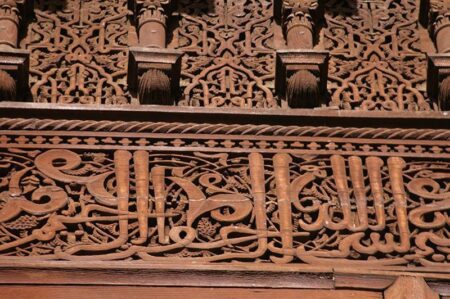
Parquet is an intruder in a room decorated in the Moroccan style. In Morocco, parquet is a floor that can't be washed or refreshed, and wood that plays with humidity.
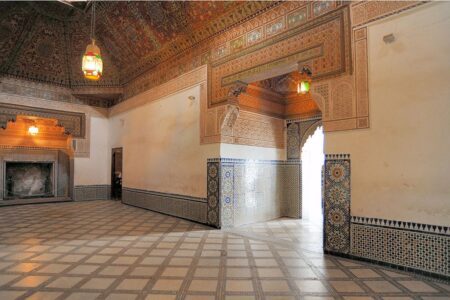
The Bahia Palace in Marrakesh lost all its furniture in the 19th century. The seat of the Residence under the Protectorate, its luxurious woodwork has been restored and showcased, a monument to Moroccan craftsmanship.
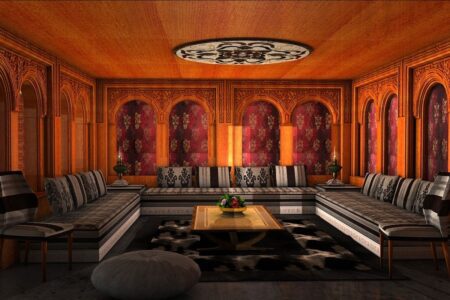
The Moroccan living room, or "sedari", is typical of Moroccan decoration and is not found in other Maghreb countries. It is based on the structure of a tent, with long sofas arranged against the wall and small pieces of furniture that are easy to transport.

