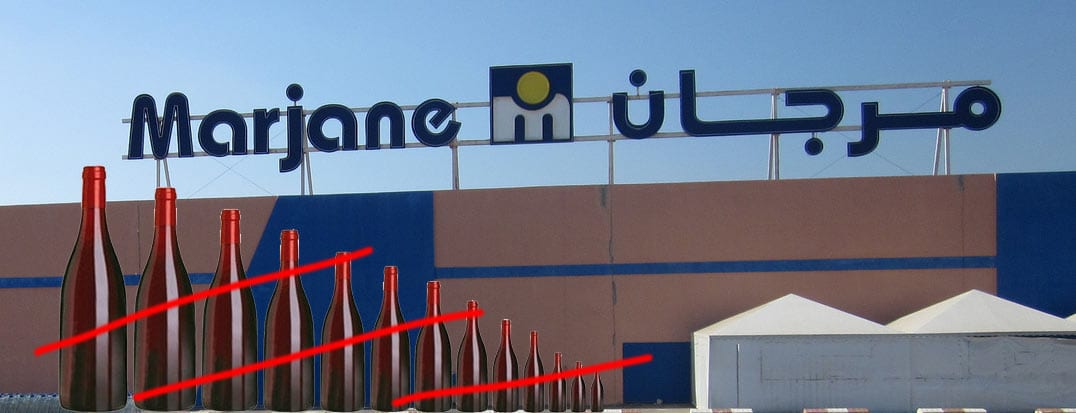
The first announcements that Marjane supermarkets were stopping the sale of alcohol, which came after Ramadan 2012, had led people to believe that the brand intended to stop selling alcohol in all its shops.
At the time, the group had made it clear that this was not an ideological or religious decision, such as the one promoted in 2010 by the mayor of Fez, but a practical one, aimed at safeguarding the quality of access to the shop for its customers. Indeed, the first three Marjane stores affected by the measure were located near working-class neighbourhoods, and it appears that customers coming to buy alcohol were disturbing the peace of local families, with regular fights and incidents.
Following the closure of these first three shops, Marjane will gradually phase out the sale of alcohol in many others, leading up to today’s announcement of a complete end to the sale of alcohol across its network.
Whatever may have been said about it, the motives appear to be essentially economic.
Indeed, Marjane continues to sell, without any restrictions, pork-based products, which are also forbidden under Islam and which, unlike alcohol, are even considered impure.
If it isn’t a religious motivation, what is it that prompts Marjane to give up selling alcohol?
Quite simply, it’s a question of weighing up the profits generated by alcohol against the drawbacks.
It is important to note that, in theory, the sale of alcohol is prohibited to Muslims in Morocco.
Although this ban is only actually enforced during Ramadan, it nevertheless continues to pose a “threat” to establishments that fail to comply with it, which still risk being fined.
Secondly, a liquor licence is expensive, and it is becoming increasingly difficult to obtain one under the Benkirane government.
Finally, whilst many Moroccans do drink alcohol, there are also many Moroccans who do not wish to have anything to do with it, or to be around people who drink, even if they are not drunk. This is what makes ‘family-friendly’ restaurants (a well-established term in Morocco meaning ‘alcohol-free’) so popular, and it is not uncommon for local residents to protest against the opening of a shop selling alcohol.
Marjane had been one of the first supermarkets in Morocco to start selling alcohol on a widespread basis, without any restrictions. Other chains had followed suit (Acima, Carrefour – La Belle Vie, etc.), but others, such as Aswak Assalam, had not done so.
It seems that the decision taken is more a result of economic constraints and a marketing analysis than anything else.
 A typo or syntax error? You can select the text and hit Ctrl+Enter to send us a message. Thank you! If this post interested you, maybe you can also leave a comment. We'd love to exchange with you !