… or the real Morocco, between tradition and modernity.
The tradition, which is omnipresent, consists of seven days of celebration, with the entire khabila (tribe) іnѵіtеԁ according to specific criteria, all the inhabitants of the bride and groom’s village, and then representatives from each other village, chosen according to affinities, prestige, honour… and availability, because August is wedding season, so everyone has to be skilfully distributed among the different celebrations, without missing a single one or offending anyone.
Tradition consists of rituals that are sufficiently alive that those participating in them do not feel as though they are playing a role, but are fully immersed in the experience.
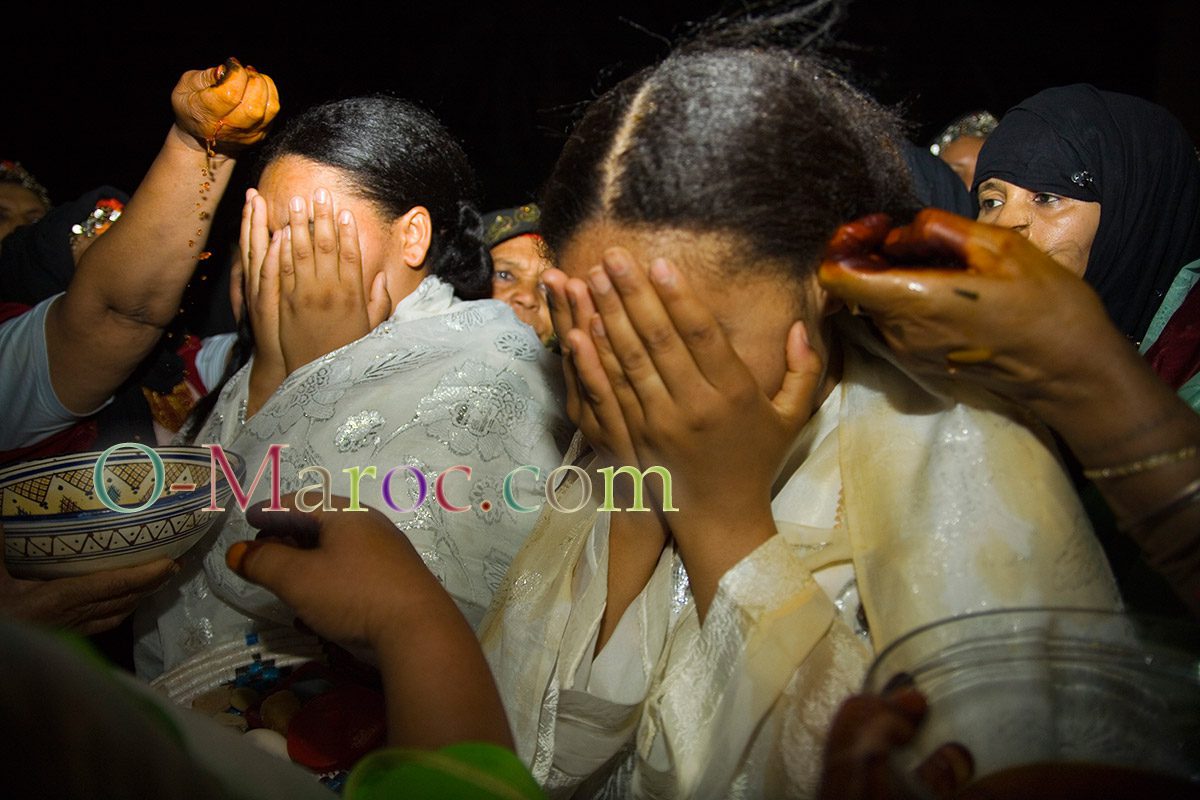
In ‘our’ south, henna is extremely important. The wedding celebration begins with the bride’s ‘first’ henna, which takes place in front of the house, surrounded and protected by women. She hides her face with her hands while one or two older women paint her hair with very liquid henna.
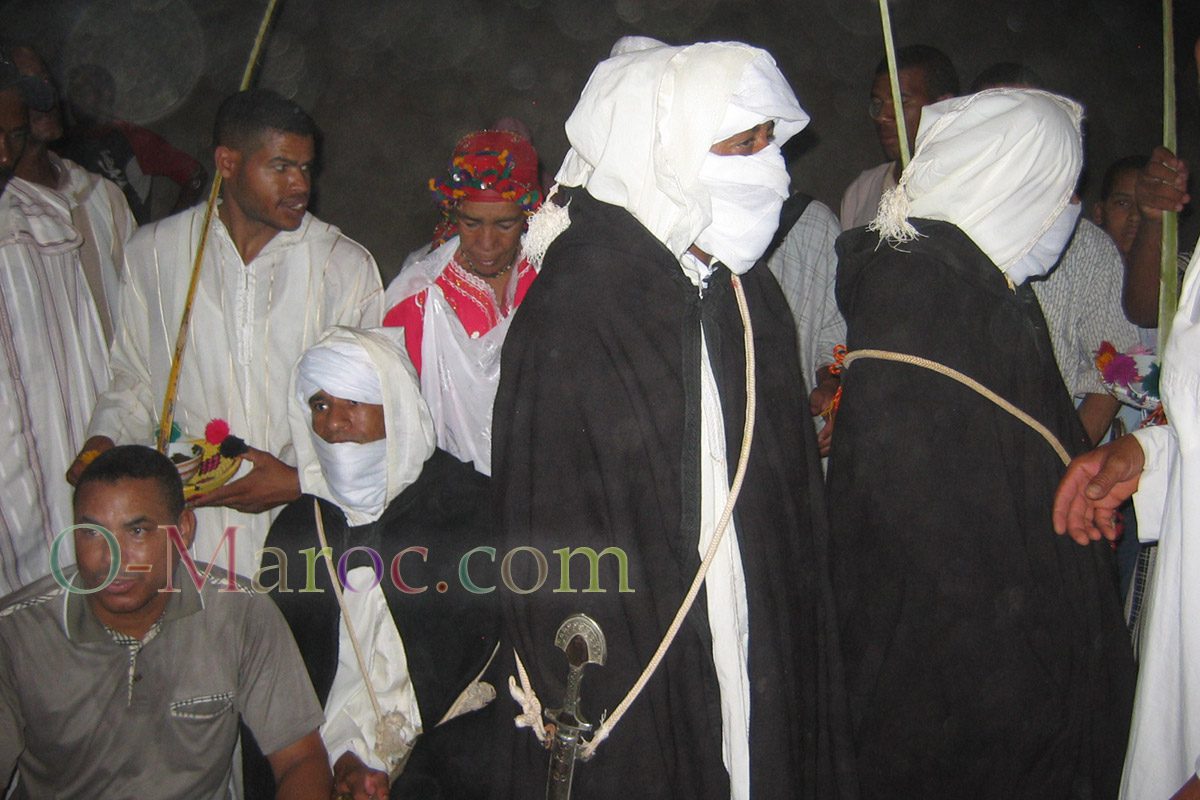
Then it will be the groom’s turn to be taken by a group of men to a square, covered in henna, dressed in white, wrapped in a black woolen burnous (it is the middle of summer in the desert), and wearing a white turban. His face will also be covered, and he will not show himself uncovered until the wedding.
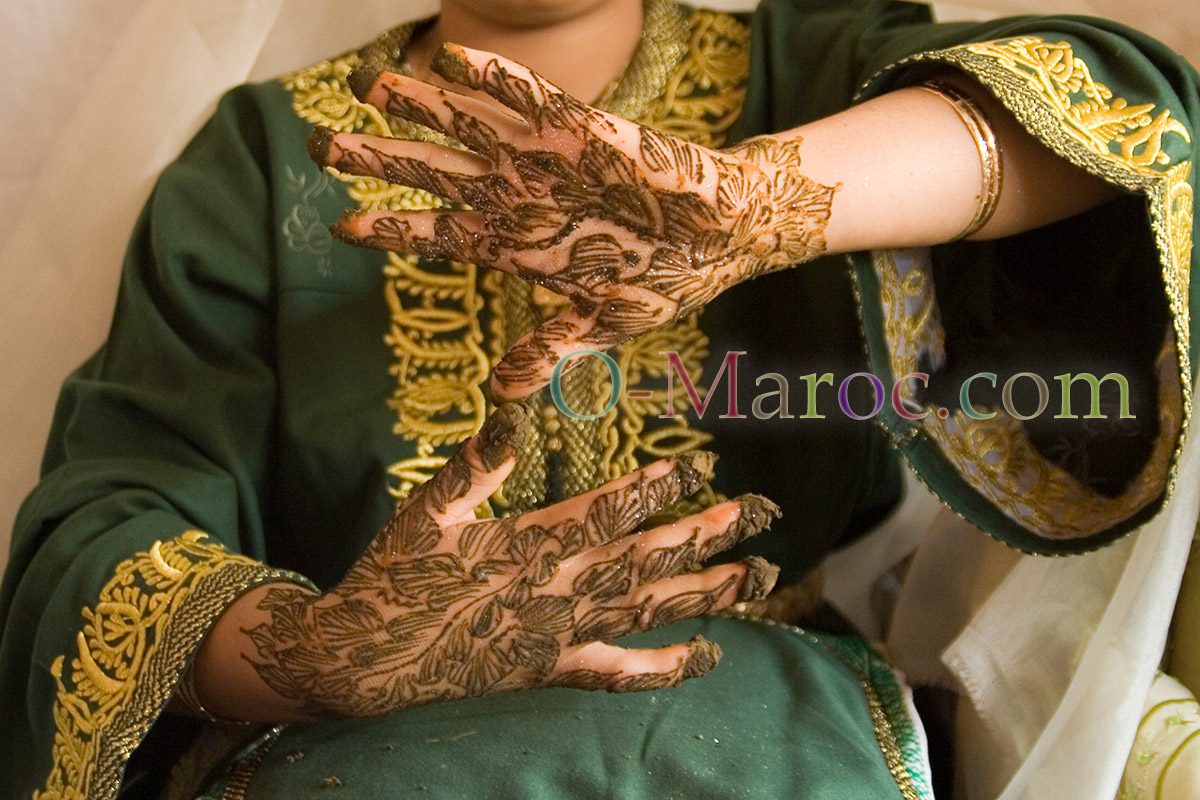
Henna for women, once again, but this time for the guests, who will have at their disposal several experts in traditional geometric patterns and floral designs that are currently in vogue.
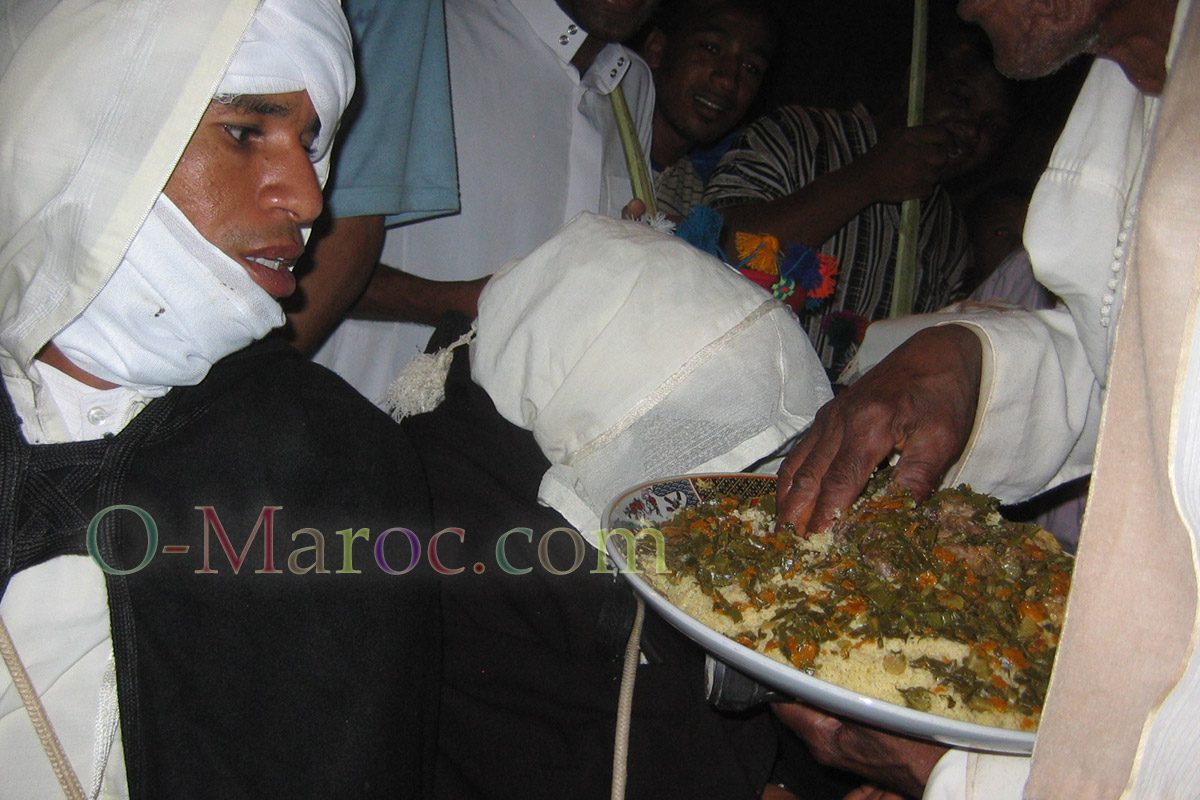
Then comes the sacrifice of the groom’s sheep, whose slaughter and butchering is accompanied by the village inhabitants singing the ahwach, and praises for the groom, who must taste a few pieces of raw meat.
And God knows that Moroccans hate raw food!
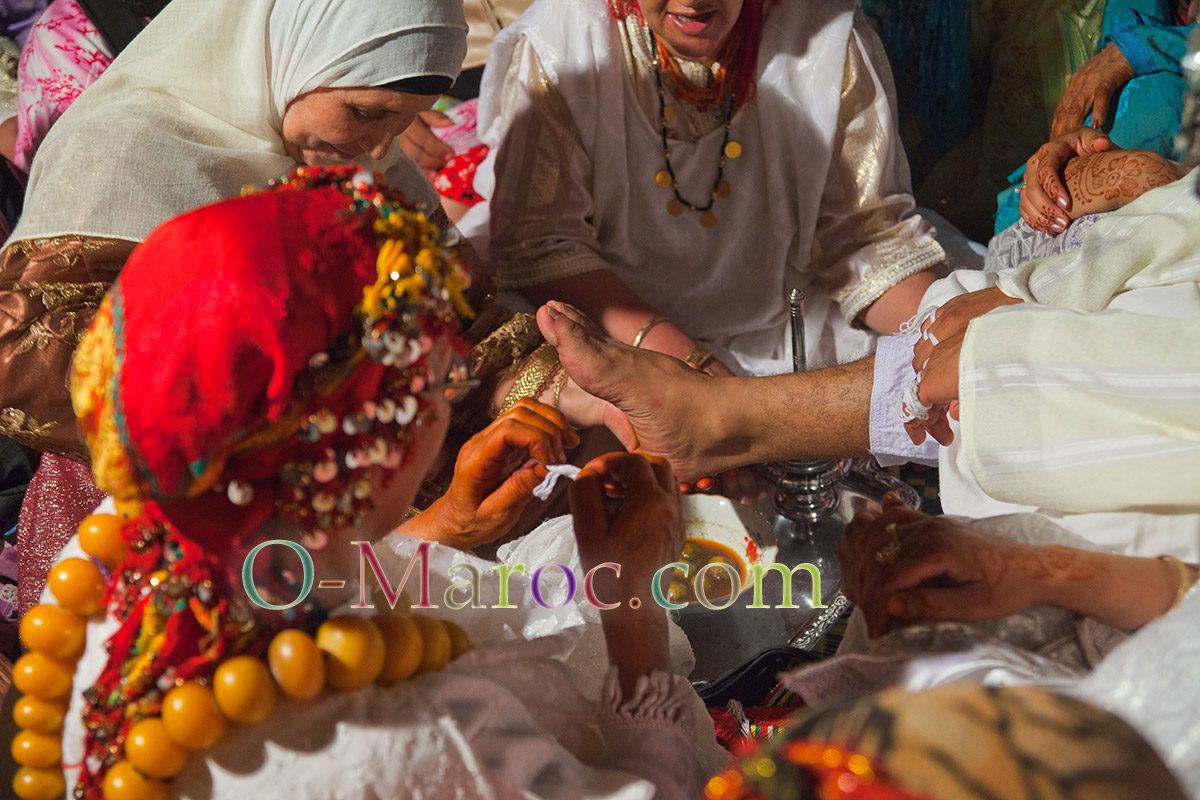
Next comes the women’s celebration and the bride’s second henna ceremony, during which her hands and feet are richly tattooed. For this occasion, she dons her finest caftan, all the jewellery she has been given, and in particular a gold belt.
In a burst of modernity, or rather a tradition from the North, the bride will wear seven different caftans on that day, each time showing herself off, having her photograph taken with the guests, and throwing sweets to the children.
Finally, on the last day, the last henna ceremony for the bride, the rite of passage, she sits surrounded by the women of her family, her face still hidden behind a red veil (she is the bride from the Draa valley, the Aït Atta bride…) while the women sing in chorus, taking turns to chant a deep, slow melody that never stops. She is prepared one last time, covered in henna, her hair completely reddened and braided, lengthened with strands of wool. She is covered with a white veil, then a black burnous, and a dagger, almost identical in every way to her fiancé…
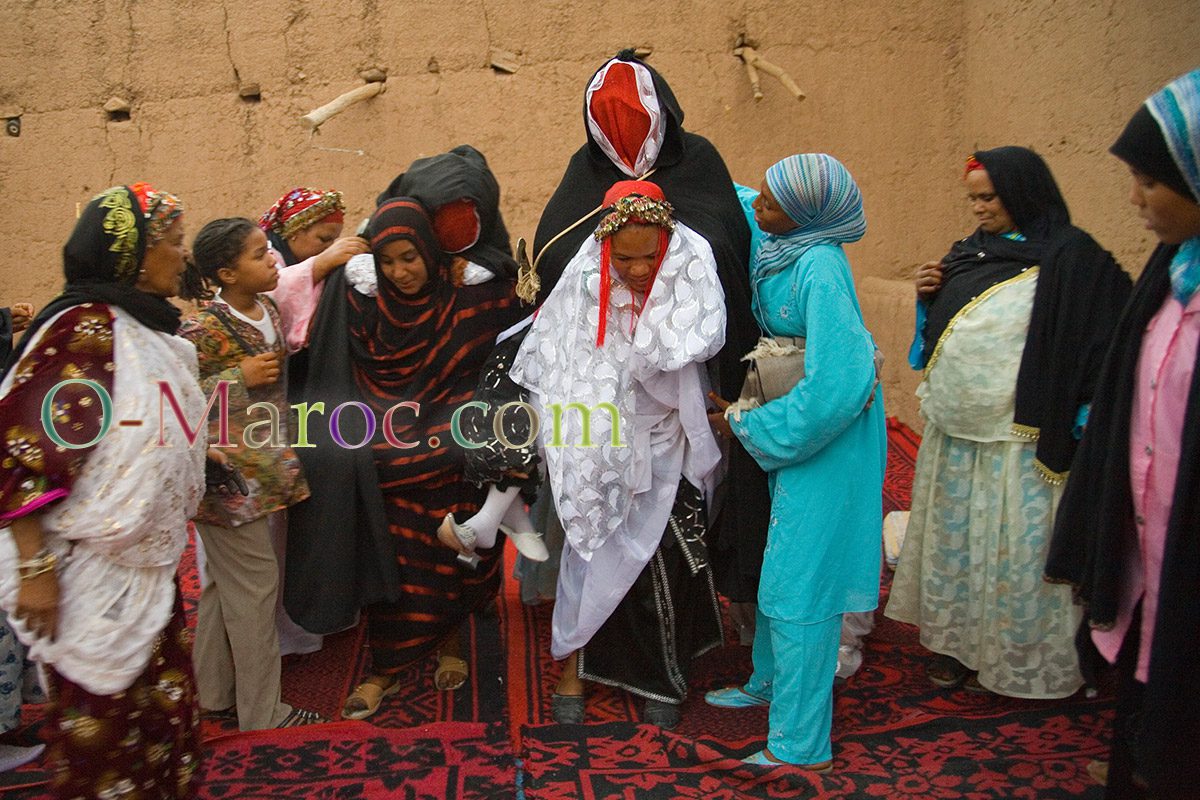
She will leave the world of childhood on the back of a woman who will carry her out of her father’s house, without her feet touching the ground.
Then, in a car honking its horn (here comes modernity again), she drives around the village, surrounded by women who now sing wedding songs to the beat of goatskin drums. She finally stops in front of the groom’s house, where she is carried in, while the men sing prayers and blessings. The entire audience, the delegates from the kbila, and the family remain below, in the street or in the large living room, waiting… waiting for the sheet, proof that the marriage has taken place according to the rules.
What I have already experienced several times in Tazzarine, Zagora, Beni Zouli and Tineghir is a tradition that no longer exists in cities.
And yet, among the guests are also exiled members of the kbila, those who are executives or civil servants in big cities, wearing three-piece suits like bankers in Casablanca or emigrant merchants, who have forgotten everything about the modern world by putting on white djellabas under their dark burnouses.
The ‘two Moroccos’ – the modern and the traditional, the urban and the rural to paraphrase La Fontaine – are much more intertwined than we might initially perceive. In Berber country, the tribe is still the structuring nucleus, and in ‘non-Berber’ country, or in large cities, territorial enclaves are legion, with people from one village or another gradually nibbling away at one Hay or another.
So, of course, the economic reality cannot be ignored. Globalisation is here to stay, the rules of the global game cannot be changed, and Marrakesh property is overpriced.
But to understand Morocco, we must not forget that perhaps, in this month of weddings, the banker who decides on loans has travelled down south, honoured to be asked to hold a male palm branch while henna is applied to a young peasant who is not very wealthy, but whose lineage goes back to a Sidi from the early days of Islam, who has two cemeteries… (And one day I will have to tell you about [myurl slug=”llnfl_zaouia” anchort=”the importance of zawiyas in modern Morocco”]).
One of Morocco’s distinctive features is that it was only subject to foreign occupation for around fifty years. Few non-Western countries can boast the same record… Japan, for example, whose ruling dynasty, like the Alawites, is one of the oldest still in power.
This independence and the closure of the kingdom to foreigners from the 18th century onwards forged a culture and tradition that is now one of Morocco’s main challenges: to develop with, not against; to transform without betraying; to improve; to use rather than suffer.
 A typo or syntax error? You can select the text and hit Ctrl+Enter to send us a message. Thank you! If this post interested you, maybe you can also leave a comment. We'd love to exchange with you !