
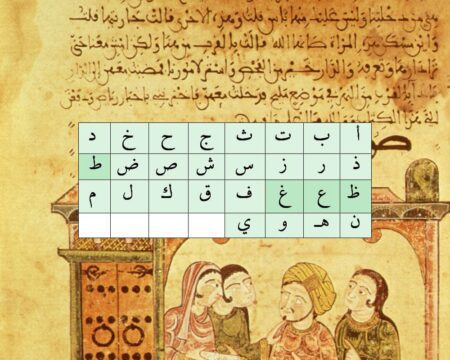
And now we've come to the end of our writing lessons, with four letters that are easier to write than to pronounce... Zâ, Ayn... the ones that a foreigner will never be able to pronounce perfectly..
And now we've come to the end of our writing lessons, with four letters that are easier to write than to pronounce... Zâ, Ayn... the ones that a foreigner will never be able to pronounce perfectly..
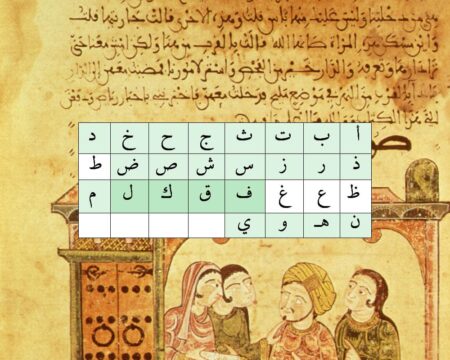
In the fifth lesson, we learn how to write - easily - the Arabic ‘Ks’ that are difficult to pronounce, the Lâm (easy) and its special feature, the Lam Alif.
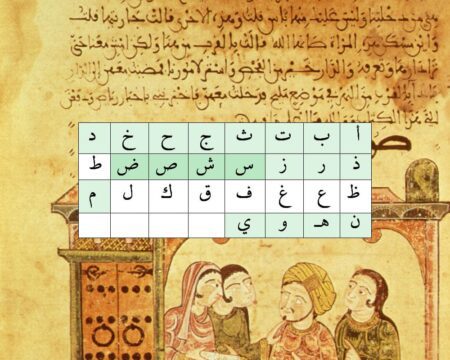
Four very pretty letters, easy to write - two are rather difficult for the French to pronounce, but for now, we'll take care of the writing!
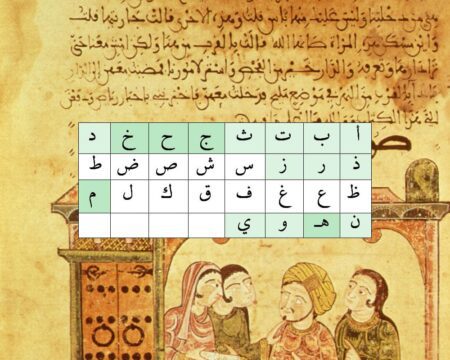
Today's lesson is about ‘beautiful’ letters (at least for me): jim and its declensions, mim and ha
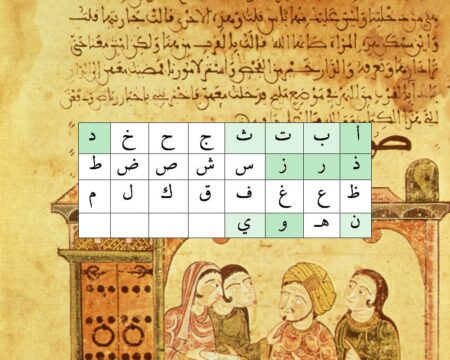
La leçon d'aujourd'hui porte sur les lettres qui ne s'attachent jamais dans les mots : elles ne changent pas de forme et sont faciles à écrire !
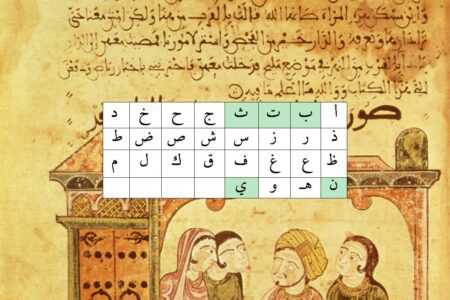
We start with five very easy letters that look alike and are easy to pronounce, and form our first two words! بنت and بنتئ
Moroccan Arabic has its own particularities, which can complicate learning Arabic in Morocco: standard or darija

Mediterranean languages have been mixing for a very long time, what Louis-Jean Calvet calls "mixed languages", with examples from Antiquity to the present day.

An official language recognised by the constitution, Amazigh is above all an oral language that has managed to survive through the centuries and assert its culture.

The pomegranate, a fruit of the sun symbolising abundance, whose Berber name is Taṛemmant, very similar to the Arabic Arrouman.

The dromedary is an animal of the desert, of sand and stones. It cannot plough, and the ‘dromedary's furrow’ is a symbol of work that does not progress. Like much of the work in Morocco!

As in French, fireplace or foyer (almessi) defines the family. The oven (afarnou) gives its name to a much sought-after bread in Morocco, which every Berber housewife knows how to prepare!

Wheat is threshed on dedicated areas of land (threshing floors) covered with stones or on terraces. The same word, Anrar, is used for football pitches.

Find out what words the Berbers use to describe a river or stream. Assif, Aqqa, Taqqat (the little valley, the little river), for example...

Tizi means mountain pass. A mountainous country, with its three Atlas mountains, Morocco offers visitors many vertiginous tizi, the best known of which are between Marrakesh and Ouarzazate, on the one hand, and Taroudant on the other.

There are many words for sheep in Berber, depending on their colour, behaviour and age. Anougoud refers to the young male sheep that will be killed at Eid time, and also to its meat.

