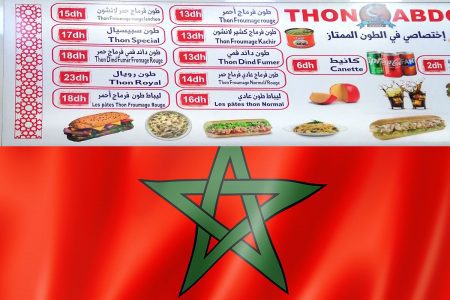
Please note: you must start with Fusha if you want to learn Arabic. If you want to understand and make yourself understood in Morocco – without, for example, being interested in the news on television – you can start with Darija.
The number of varieties of Arabic is a little difficult to grasp. One day I shall return to the subject of the evolution of the Arabic language, and the turning point marked by the revelation of the Qur’an, as this is a subject that fascinates me. In the meantime, to summarise, there is a ‘standard’ Arabic, with several levels of sophistication, and ‘local’ forms of Arabic, which are the dialects.
L’arabe classique / standard
Standard Arabic is also known as الفصحى, and forms the basis of written Arabic. It actually encompasses both literary Arabic (which is also the Arabic of the Qur’an) and modern, formal written Arabic. It is the form taught in schools. Modern Arabic, also known as فصحى العصر, is a simplification of Classical Arabic but does not alter it. It is somewhat similar to the changes that Chinese underwent after the revolution (and the simplification of characters), or quite simply to those in French following its spelling reforms!
If we compare this to the evolution of the French language from Latin, let’s imagine that we were all obliged to take all our school lessons in Latin – but in a modern form of Latin, capable of discussing lifts and computers (and which does exist; it’s spoken in the Vatican, and there’s even an ‘Assimil Latin’ course). But it would still be Latin. With a few variations in local pronunciation (such as the southern accent compared to the sharp accent of Parisians).
“Dialects”
Alongside this Standard Arabic, the language has evolved over the last 1,400 years. The changes have been far more profound. Whilst the Arabic substrate is still present, the vocabulary has diverged considerably, depending on the history of each of these countries; pronunciations have strayed significantly from the standard; grammar may have changed; and, finally, common expressions vary (such as ‘pain au chocolat’ and ‘chocolatine’ in France).
The various dialects are divided into four main groups:
- In North Africa, Darija
- In Egypt, Masri
- In Middle East, Shami
- In the Gulf countries, Khaliji
which will themselves be subdivided into numerous sub-groups, until we reach the level of differentiation that corresponds to our local dialects.
These ‘dialects’ are the ones you need to speak and understand in everyday life, depending on the country you live in. Compared to our standard Arabic, they are the languages of today: Italian, French and Spanish. If you have learnt the standard form, you will find it easier to learn and understand the dialect.
The second reason why studying the standard language is so important is spelling. In dialects – at least in Shami and Darija, for example – the letter ‘Tha’, which is pronounced like a soft English ‘th’ (as in ‘thing’) in the standard language, has become a ‘t’. Instead of saying ‘thalatha’ for ‘three’, one says ‘talata’. But it is still written with a ‘tha’, and if you are unfamiliar with the standard form, you will find it much harder to remember the spelling – and therefore to READ. Because even though we are writing more and more in ‘Darija’, we retain the standard spelling for words that have simply changed in pronunciation.
Are you an auditory or visual learner?
We all have our own way of approaching a language. If you’re mainly a spoken language learner, if you’re not interested in newspapers, learning Standard Arabic might be a pointless step. But if, like me, you have a visual memory and you want to read Arabic – particularly modern authors – then start with Standard Arabic: for an adult, it’s much easier to learn the basic rules and their variations than to start with a variation, with all its anomalies.
And my Latin and Greek lessons at school have given me a good command of French spelling, which I hope to have one day in Arabic!
 A typo or syntax error? You can select the text and hit Ctrl+Enter to send us a message. Thank you! If this post interested you, maybe you can also leave a comment. We'd love to exchange with you !